
Much anticipated, Sanskriti Sagar’s resurrected Sabhagar Theatre Festival delighted Kolkata audiences starved of platforms featuring mainstage productions from outside. Three of them shared an unusual trait of surreal, nonlinear, loosely-linked narratives that slipped in and out of various stories, all three based on old sources. It proved an object lesson in subverting and educating theatregoers accustomed to conventional straightforward plotting, exposing them to alternative dramatic structures.
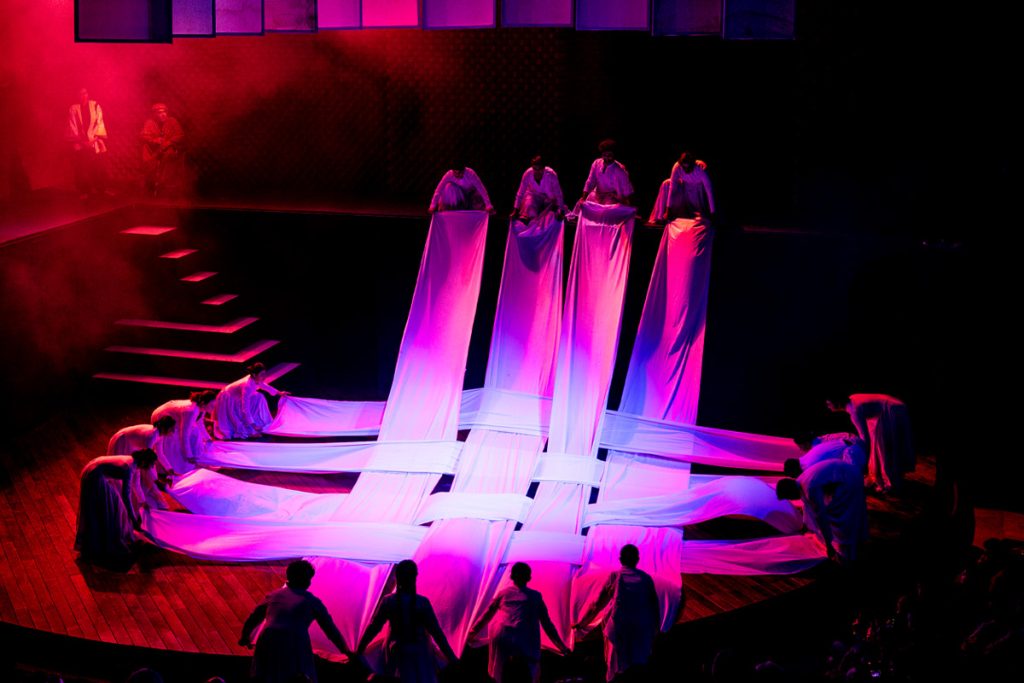
Celebrating Darpana’s 75th anniversary, Meanwhile Elsewhere resembled poetry and painting in motion onstage. Writer-director Yadavan Chandran, inspired by Italo Calvino’s postmodern novel Invisible Cities, matched its dreamy yet intricately mathematical patterns typical of the Oulipo movement with his own lambent lighting and sound, Mallika Sarabhai’s geographically diverse costumes and the mathematically aesthetic virtues of dance, choreographed collectively by Sarabhai, Lucrezia Maniscotti and Penelope Deen. Creating breathtaking visuals like the interwoven warp and weft in the photo above, in the tradition of such pioneers as Robert Wilson’s “Theatre of Images”, it lived up to its caption of artistic fragility: “To pull one thread is to fray the whole”. One must simply allow oneself to immerse in the experience.
Calvino’s imaginary retelling of Marco Polo describing to Kublai Khan 55 cities named after women (therefore four actresses enact Marco) has a magical internationalism that Darpana crystallizes through its multi-ethnic and multilingual cast speaking seven languages, Indian and European, recalling to us Tim Supple’s Midsummer Night’s Dream. The cities do not represent anything historical, but instead portray the urban homogeneity of today, including specific references to Ahmedabad and in the finale, Gaza, to which the play builds. More than Yadavan’s comment that “beauty and ruin live side by side”, the lyrical dance-derived rasa sublimates reality in every scene, like the street sweepers brooming away the dust and sneezing in sync, or the lorry driver giving a lift to an Italian hitchhiker without any communicative link, where every moment we fear something horrible. I hope Meanwhile Elsewhere has a long run.
Finally I got to see a play by the much-feted Abhishek Majumdar, Kaumudi, which he wrote in Hindi in 2014 and directed for D for Drama. He is a most rare phenomenon, composing scripts fluently in different languages. He took the idea of Kaumudi from Anand’s Malayalam novel, Vyasa and Vigneswara, where Anand fictionalized a meeting of Ekalavya and Abhimanyu. Majumdar places this encounter metatheatrically in an Allahabad company that relies on the drawing power of a senior actor (Kumud Mishra) as Ekalavya’s ghost, soon to be supplanted by the young Sandeep Shikhar, who plays Abhimanyu in another company. Majumdar complicates it further with that old trick, a personal layer of long-estranged father and son.
Some dubious tweaks of the source material caught my sceptical eye. Majumdar identifies Ekalavya as an outcaste Chamar, whereas the Mahabharata clearly calls him a forest-dwelling Nishad, a crucial opportunity missed to condemn our current appropriation of tribal foresters’ rights. He also interprets the dog episode incorrectly: it was the Pandavas’ dog, not Ekalavya’s, and Ekalavya didn’t kill it. While Majumdar shows Ekalavya questioning Krishna on dharma, he does not mention that the Mahabharata says Krishna slew Ekalavya, missing another key indictment.
In interviews, Majumdar speaks of three central questions in Kaumudi: whose life is more valuable, young or old? Does the personal or the public have greater importance? Does art make us or do we make art? These are immature binaries that should not occupy Majumdar, because the answer to all three is, obviously, Both. As for dispensability, the two reporters and the drunkards’ burlesque about what constitutes drama digress, and Ekalavya drowning his dog is an overdone reiteration of the father leaving his boy to a watery death.
The four men in multiple roles save the play. Mishra does a star turn as the near-blind veteran as well as Abhimanyu’s mother, Subhadra. Shikhar portrays a talented junior actor full of himself. The two sidekicks are not just supporting cast: Gopal Datt often threatens to upstage the principals as the theatre manager and Krishna under criticism; Shubhrajyoti Barat, the company menial, also chips in as an ineffectual Arjun. As a team they spark splendidly and capture the rustic humour in provincial performances, too.
Much more so, Katkatha’s members stand head and shoulders above their playtext. Director Anurupa Roy’s choice of scripts has never excited me, continuing on this one, which she regards as their deepest so far. The writers, Neel Chaudhuri and Adithi Rao, ostensibly dramatize the Thousand and One Nights but in fact compress just four of the tales along with the frame, three of them too familiar to surprise. Moreover, Aladdin and Ali Baba do not belong to the original Arabic collection, only added from other sources in the 18th-century French translation. The Sindbad cycle, too, was separate to begin with, incorporated in the omnibus compilation later. So Katkatha’s misnomer title, The Nights, unfairly ignores most of Shahrazad’s stories that remain relatively unknown.
The single genuine original included here, that of the beggar Abu Hasan and Caliph Harun al-Rashid, receives short shrift from Chaudhuri and Rao, compared to the others. However, their bilingual (English and Hindi) dialogue suits contemporary usage, with Roy speaking some lines in Bengali too. The overwhelming thematic effect in The Nights is of the darker and violent content.
In terms of form, Roy uses Japanese Bunraku technique, where three or four puppeteers, dressed mostly in black, manipulate each larger-than-life puppet. Their skills and stagecraft are incredible, but still short of the pinnacle of Bunraku illusion, in which the puppet seems to lead the puppeteers, not the other way round. To Katkatha’s credit, they also perform parts as human actors in a hybrid puppetry-plus-theatre mode.
(25 November 2025)