
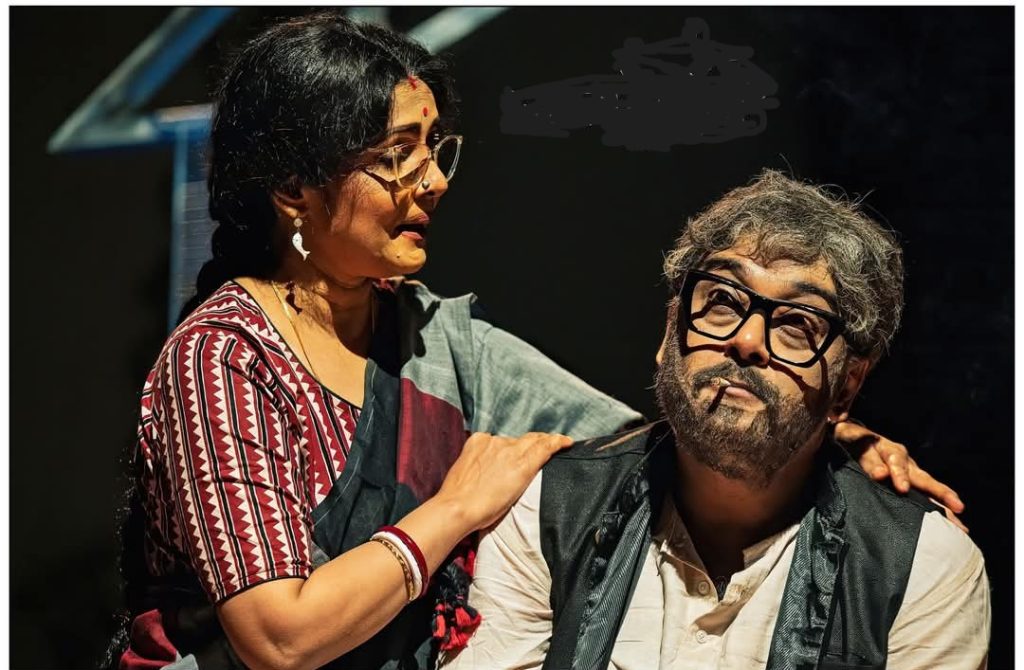
Ritwik Ghatak’s centenary began in November, and Bengali theatre has celebrated it so far with two tribute productions: a biography and a revival. Meghe Dhākā Ghatak continues Chetana’s ongoing success with biodrama after Mahātmā Banām Gāndhi, by the same director, Sujan Mukhopadhyay. But the impact of Meghe Dhākā Ghatak is equally due to the author, Jeet Satragni, in one of his best plays to date.
He does several unusual things: he does not write a hagiography, but throws light on Ghatak’s inner life “obscured by clouds”. He gives ample space to Ghatak’s wife Surama, their love and increasingly disturbed marriage, as well as her undying support for him. He exposes the wheels running Bombay’s movie industry that disenchanted Ghatak—unwilling to compromise with that machine—consequently earning him little leverage there. He reveals the irony of someone who disdained liquor becoming an alcoholic, which finally killed him.
The collaboration with Mukhopadhyay reaps rich rewards in its filmic allusions. The script underlines Ghatak’s feminism in his cinematic characters like Nita, Sita and Bangabala, as well as Bimal and Kanchan, all of whom appear as hallucinations to Ghatak. The actors sync well with the montage clips, especially Rajat Narayan Bhattacharyya (Bimal), and from the screenplay “Mannequin”, the marionette-like Mary Acharya in the eponymous part and Agnijit Sen as her devotee. But this 150-minute production rests squarely on the shoulders of Sujan and Nibedita Mukhopadhyay in a tour de force as the troubled souls, Mr and Mrs Ghatak (photo).
My only criticism lies in the contradiction posed between Ghatak quoting Brecht’s instruction to prevent the audience from attaining emotional catharsis and Sujan luxuriating in exactly that at the end to evoke sympathy, instead of Brecht’s advice to practise lehrstücke, “learning-dramas”.
The other absence in Meghe Dhākā Ghatak is referencing Ghatak’s own plays, unknown to the public in the huge shadow of his films. Viewers interested in this aspect of his oeuvre should see Belgharia Ruptapas’s Sānko in the wake of Partition, which still makes a strong statement. Therefore it provides an essential companion piece to Chetana’s production.
To clue readers in to the storyline without giving away any spoilers: Ghatak set his drama at the time of communal riots in Kolkata during the 1950s, in a Hindu home where a Muslim youth visiting from East Pakistan hides from a bloodthirsty mob. The scene changes completely in the second half, to the village home of the young man across the border. Ghatak constructed the plot to protest the senseless killings and as an appeal to Hindu–Muslim harmony.
 Kaushik Ghosh directs the nerve-wracking Act 1 with high tension as Hindus wielding weapons rampage through the streets, but later repeats the crucial moment of violence on the soundtrack too often in the law of diminishing returns, and he too does not tone down climaxes as Ghatak called for (see above). However, every member of the accomplished cast contributes by individuating their character. Sumit Kumar Roy acts Sagar, the bridge between the halves, as an upright but impulsive man who seeks closure, complemented by equally good singing by him and Sunny Barik as Mahsin, normally never evenly matched in revivals of Sānko. Act 2 glows with Sumita Basu’s performance as the mother, her Bangal accent perfect, and Tanusree Saha as the mischievous but politically active Jaba (photo), the role created by Surama Ghatak herself in the original 1954 production by Ritwik’s new group, Group Theatre.
(25 March 2026)