
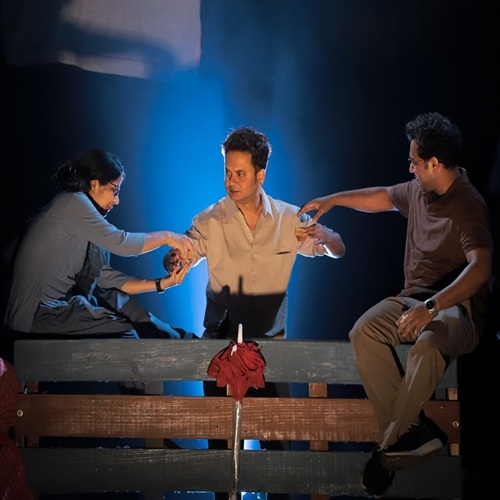
Je Jānlāgulor Ākāsh Chhilo achieves another success for Ichheymoto. Based on two stories from Rahul Arunoday Banerjee’s book Kalkātā Kyākophoni (Cacophony), the dramatization by Saurav Palodhi conjures a profound sense of Kolkata’s nearly-lost pārā culture, where everybody in a lane or two knew everyone else living nearby—as late as the 1990s, the period in which the four friends in the play grew up in Bijaygarh Colony. Most commentators have harped on its nostalgia (which always attracts Bengali sentiments), but I prefer to call it melancholia, because much more than simple, clichéd romanticism about the past, it evokes intense anguish about close comrades drifting apart politically and professionally as adults, which bestows universality and a lasting stamp on it.
A lot of this has to do with Banerjee’s poetic imagery, his simultaneous immersion in Kolkata and transcendence into the distance. If I may digress into the source, he writes of revelling in “the noise of this city”, a most unlikely inspiration, saying about it: “If I put my ear to this cacophony I can hear the sound of distant waterfalls. Sea waves break at office-time Esplanade” (my translation). This kind of dual tonality marks his originality.
The play weaves in and out of several stories, the core foursome referring to many other persons who entered their ken. This can become centrifugally unwieldy, the most tenuous thread being the old man at the window—though it is the iconic showpiece of the set, scatter-lit through its shutters by Soumen Chakraborty, as well as the focal noun in the title, therefore difficult to remove. Director Palodhi also lets in two slips in credibility: none of the quartet keep in touch even with a letter after the girl’s family gets transferred, and they receive a message in Bengali from an Anglophone wife. A few sequences have turned into far too commonplace tropes in contemporary theatre, like umbrellas in the rain and a bicycle on stage. But the audiovisual background aptly uses mainly Hindi film music and TV snippets to establish temporal context, even if somewhat prolonged at the start.
I cannot point out any lacunae whatsoever in the large cast’s acting, from subtle conversations and love scenes to group dynamics, led by the friends (Banerjee himself [photo centre], Turna Das, Krishnendu Saha and Buddhadev Das, two of them in double roles) and their childhood counterparts (Wridhhyan Dasgupta as all three boys, and Meghatri Mondal) and veteran Bimal Chakraborty as the grandfather who hates/loves his son-in-law. I found Buddhadev’s inability to cry when he hears of his best buddy’s death on foreign shores a superlative emotive touch.
(16 March 2026)
Postscript: On March 25, Je Jānlāgulor Ākāsh Chhilo, the only production from Kolkata shortlisted at the Mahindra Excellence in Theatre Awards in New Delhi, won the Best Director, Best Stage Design, Best (Female) Actor and Best Ensemble awards. Palodhi’s directorial note for META ended with these lines: “friendship is … about looking out for that friend with whom you played hide and seek as a child. May friendship survive; may it thrive.” On March 29, Rahul Banerjee died tragically in the sea during a shoot. May his friends ensure that his show goes on.