
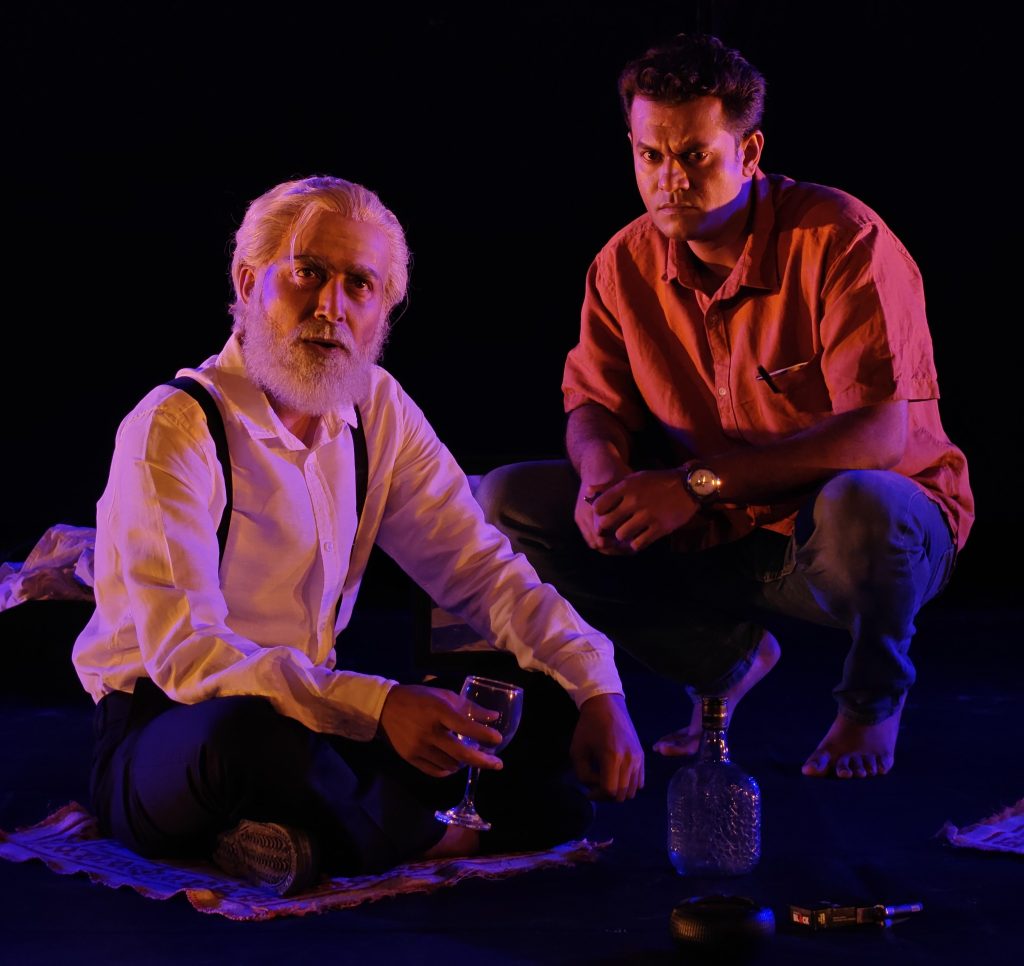
Kolkata Centre for Creativity’s programming continues to bring theatre from outside, particularly enabling us to view small-scale productions that fit their space and otherwise may not get invited to regular proscenium auditoriums. For example, Shantipur Harmony Theatre’s intimate Bāsābadal in March surprised me with its subtlety; although it comes from nearby Nadia, it has not had too many performances within the city, but it definitely should.
Subhashis Gangopadhyay, formerly of Blind Opera and now Anya Desh, titled his play as Bāsābadal o Bichhānā kimbā Jutor Samlāp, which director Arpan Garai understandably shortened. It speaks straight to the Bengali heart, as so many old houses give way to flat (in both senses) buildings. The subject is not new, but Gangopadhyay’s treatment is. He does not introduce the protagonist until the second half; instead, we witness a conversation between the owner’s bed and shoes, personified as a decked-up woman and a worn man respectively, providing some faint exposition but more significantly, investing inanimate household objects with life, even a soul in magic-realist pathetic fallacy. We meet the humans later, the owner and the promoter named Mahakal, which immediately transports us to symbolism and fantasy since great Time bears down on all of us, ultimately ending in a complex finale of past love.
Garai does not go for sentimental excesses as commonly found in group theatres, but dwells on the intangible. Debraj Bhattacharya as the old landlord who loves opera (he chose the music himself, replacing the original Bengali song in representing a typical middle-class bhadralok eccentric with refined taste) and Anujoy Chattopadhyay as the young broker about to make his first deal play off the extremes in their years (photo). Dipanwita Sarkar (the bed) must stop swallowing the last word or syllable of sentences, but otherwise pairs well with Arka Chakraborty (the shoes) in a parallel trade-off of youth and age. Bāsābadal reminded me of the Beatles’ line “(She’s) leaving home after living alone for so many years”, in our totally different context.
From much farther afield, Ekjute’s Ek Lamhā Zindagi narrated the relationship of eminent Urdu writer-activists Syed Sajjad Zaheer and Razia Sajjad Zaheer from the 1930s to the 1970s. It follows Nadira Babbar’s play Meri Mā ke Hāth but traverses the same ground. Where Nadira dealt more with her mother, Juhi Babbar Soni here spotlights both her grandparents. We must note two potential drawbacks, however. Not having seen Nadira’s version, I cannot tell how much of its material Juhi repeats—a measure of originality. And lamhā indicates short, transient, which we can appreciate poetically as applied to a lifetime, but it contradicts the couple’s considerable literary achievements which, now near-forgotten, demand emphasis.
Another contradiction arises: Juhi’s title suggests their lives, whereas the subtitle says “A Love Story”—the public and the private become impossible to combine satisfactorily in 90 minutes. As she acknowledges, her script had an eight-hour runtime before co-director Makarand Deshpande chopped it drastically. The Zaheers’ marriage gets covered but, if nothing else, the audience must learn more about their literature. For instance, Sajjad’s stories in Angāre (1932) sparked the trailblazing Progressive Writers’ Association; and his themes of sexuality and opposition to rituals based on ignorance upset Muslim conservatives, leading to bans. Razia, not just a teacher and author of feminist fiction, in which she disagreed with Gandhiji’s ideas on women’s place in family and society, also had a prolific career as translator. Anecdotally, she used to write and cook simultaneously!
As I have observed before, on Juhi’s With Love, Āp ki Saiyāra, her solo acting is impeccable, especially her ability to convey meaning through the minutest facial flickers, much more perceptible and therefore effective when in proximity to the spectators, as in KCC. She should just add a little more content about the Zaheers’ pioneering writing as mentioned above, to arrive at a more complete picture.
(3 April 2026)