
Biodrama in Bengali theatre has grown into a notable subgenre lately. Two of them, originally occasioned by centenaries and significant anniversaries, give spectators welcome vistas into Indian personalities of genius born in the late 19th century in poverty-stricken circumstances and about whom the general public have little acquaintance. Both use multiple points of view and do not present linear narratives, making them more complex.
Rajib Bardhan planned Jadavpur Manthan’s Ramanujan for the mathematician’s death centenary, but Covid put a stop to it. His play finally premiered last year, incorporating substantial biographical research, and interpreting Ramanujan’s mother as possessive to a domineering degree, downplaying his wife as submissive. From what the latter has related, however, the ladies lived amicably after she entered the household in 1912 until Ramanujan left “from Kumbakonam to Cambridge” in 1914, and jointly attended to his meals. Bardhan pushes fact toward fiction further by depicting the mother destroying rather than hiding his letters to his wife. Dramatists have a duty not to tweak history and misinform.
Bardhan also enlightens us on Ramanujan’s familiarity with Aryabhata and the medieval treatise Lilāvati but must rethink references to so-called “Vedic mathematics”, a dubious and politicized subject today. I recommend that he add a couple of well-documented points: that for reasons unknown, Ramanujan ran far away from home for a month in 1905 after failing several exams in college; and the famous anecdote about him giving Professor Hardy an arithmetical insight into 1729, the number of the taxi that Hardy took to his hospital.
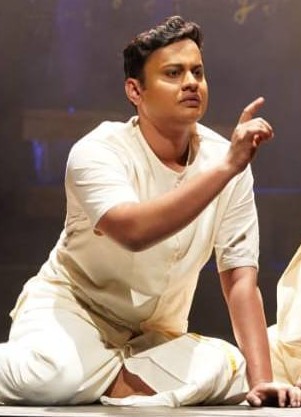 Pivoting on accomplished actors like Debabrata Das (a true tragic hero, photo) and Monalisa Chatterjee (the villainess of the piece), the production cannot go wrong, made visually attractive as well by Sanjay Pal’s authentic Tamil costumes and accoutrements for the living deity Namagiri. But a mismatch between the poor and perfect English accents of Hardy and Littlewood respectively hurts the ears, while I hope that my hearing betrayed me with “Meteorological” for Indian Mathematical Society!
Encouragingly for Rabindra Bharati University’s Drama Department, their Theatre “Repertoire” (still not having understood the difference between repertory and repertoire) has a production running for over a dozen performances already, since the 125th birth anniversary of Kazi Nazrul Islam and now in the 50th year of his death. His multi-artistic achievements have never received adequate treatment in the performing arts, but playwright Ratan Sanyamath and director Gagandeep (a faculty member) take the first step with Jhilimili Ānkābānkā.
Sanyamath covers Nazrul’s indigent youth, interrupted education, army service in World War I, socialist politics, fearless journalism, arrest and imprisonment, syncretic spiritualism, besides his rebellious poetry, lyrics and music (not many Bengalis know that he composed more songs than Tagore), film career, love life and sad deaths of children—all in the space of 100 minutes. This allows ample scope for enhanced details—particularly the important fact today that he named his eldest son Krishna Mohammad (who died soon after birth) and his misdiagnosed illness over his last 35 years—because the play ends abruptly after Tagore’s death in 1941.
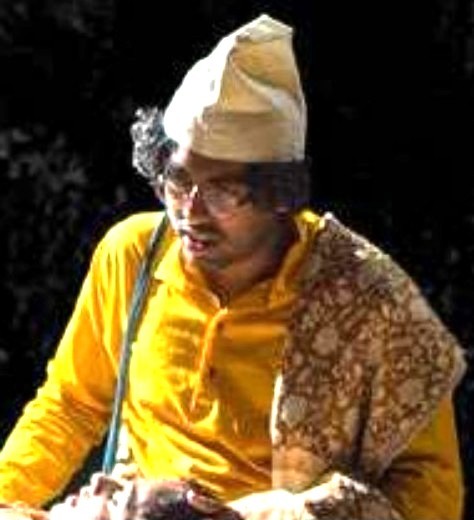 Gagandeep draws on the talented pool of students and alumni, splitting Nazrul’s character between as many as five actors, gender-blind, to represent the boy, the soldier, the musician (photo), the elder, and his inner spirit. By distributing numerous other parts among her 20-strong ensemble, she creates the impression of a life teeming with humanity, which indeed it was.
(23 April 2026)