
Having missed out on Akvarious’s Dekh Behen the first time around, I caught up with it and its sequel at The Urban Theatre Project’s Dekh Behen weekend, serendipitously enabling me to appraise them together. The pre-pandemic Dekh Behen, billed as “a fully female [and I may add ‘famous’] cast and crew”, has scored over 130 performances across India, though the double-F alliteration is somewhat adulterated by the presence of Akarsh Khurana, the token male, as co-producer.
Its full femaleness falters further because the script (credited to Dilshad Edibam and Tahira Nath) owes its origin and many other elements to a man, Alan Ball, dramatist of Five Women Wearing the Same Dress (1993). This source has the same idea of bridesmaids at a wedding, a similar dramatis personae including two with identical names (the bestie Trisha and the lesbian Mindy), the bride’s sister who harbours a terrible secret, a devout ingénue whose purloining a bracelet and hiding under the bed opens both plays, and even the balcony from which all look down at the party goings-on.
Of course, Edibam and Nath depart in their Hinglish Indianization set in Delhi, but the shocking exposé on which the end of Dekh Behen pivots, turning Ball’s comedy tragicomic, also borrows from his text, except that Edibam and Nath transfer culpability to the groom, rendering it rather unbelievable that the bride’s own sister had concealed it for all this time. Other than these gripes, Dekh Behen creates a raucous rollercoaster of estrogenic entertainment the likes of which Indian theatre rarely sees, topped by a cringeworthy item dance rehearsal.
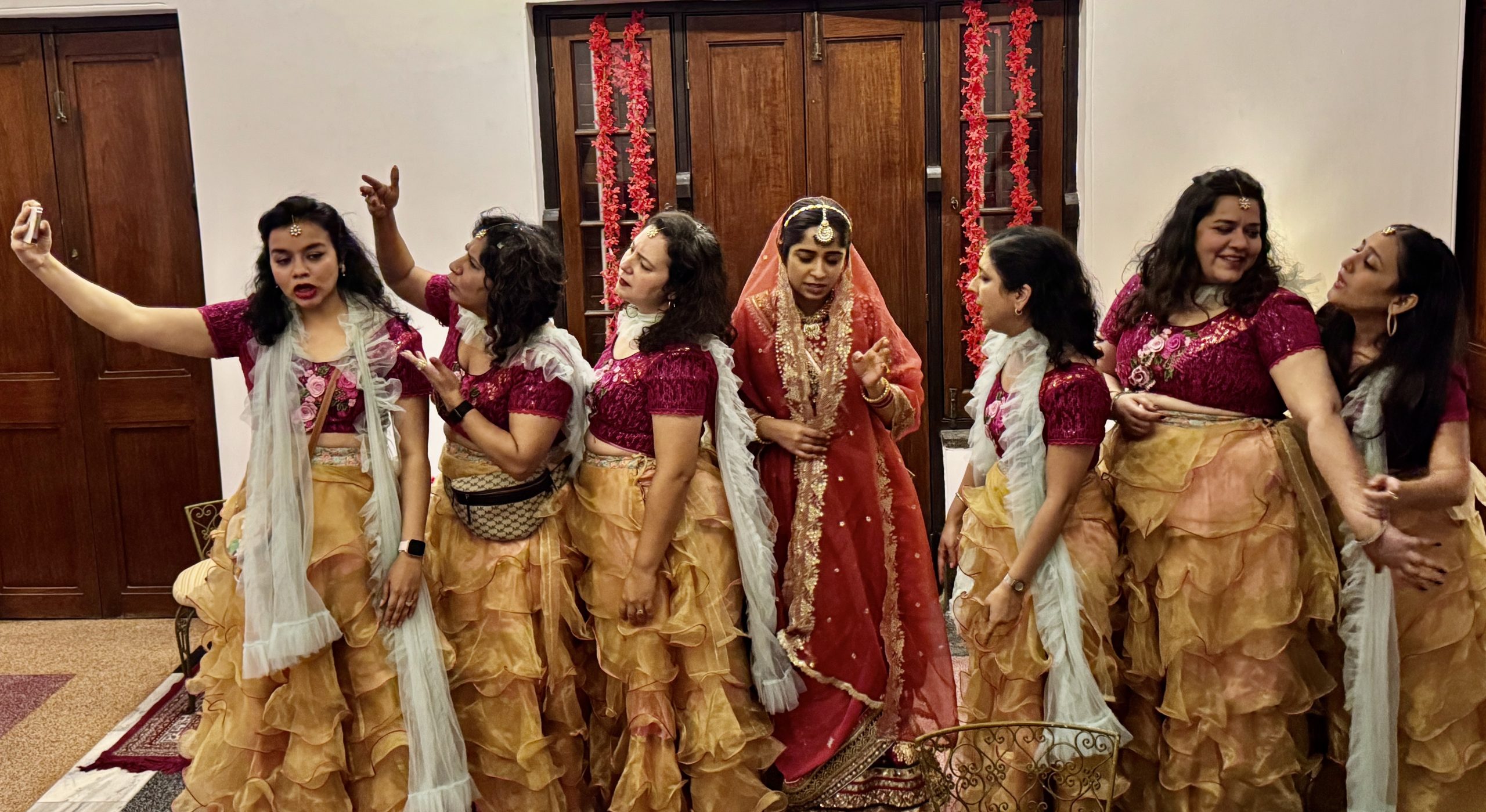
In Part Two occurring five years later, the originality quotient thankfully shoots up (I haven’t heard of any sequel to Ball’s play) and ironically makes it deeper, because the ladies’ friendships replace the first part’s relentless preoccupation with their sex lives. Exemplifying how a sequel can better its original, it presents a case for potential reversal whereby Ball should adapt Edibam–Nath’s Part Two into an American follow-up.
The ingénue, Kanupriya, marries the man she had fallen for at the earlier wedding. Interestingly, the two male cameos here look deliberately irrelevant, lightweight, flipping the common neglect given to female extras in much of dramatic literature. Time seems to have matured all the women from just easy familiarity into non-judgmental and empathetic human beings, epitomized by their bonding over the illness revealed at the conclusion.
Most admirable about both Behens is the manner in which co-directors Prerna Chawla and Shikha Talsania achieve impeccable pacing, overlapping, adlibbing when required, to conjure utterly natural portrayals and the feel of spontaneity, testifying to close camaraderie within the group’s own girl gang yet ensuring discrete characterizations. Thus, Chawla’s free-spirited Trisha, Talsania’s would-be bride, Preetika Chawla as her sulky sister, Edibam’s sassy Mindy, Nath’s bawdy adulteress, Astha Arora’s naïf Kanupriya—all develop their personal arcs as they grow older, while Lisha Bajaj joins Part Two as Kanupriya’s conservative friend (taking a groufie in photo).
Finally, as a longtime crusader against smoking in theatre, I commend this team as a model for using cigarettes without actually lighting them, whereas most male directors and actors continue to puff away to kingdom come onstage, unconcernedly endangering their colleagues’ health.
(2 May 2026)