
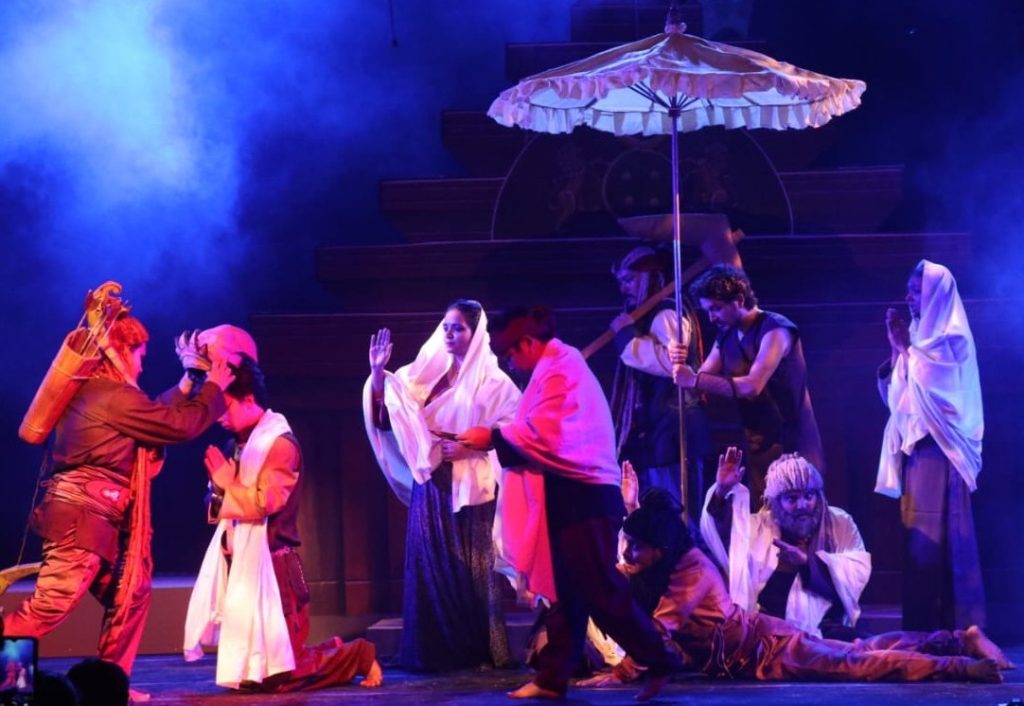
Two productions from outside Kolkata came to festivals held in December. Nandikar’s National Theatre Festival hosted the National School of Drama Repertory Company (Sikkim)’s Bhāsa-bhāratam, an unprecedented concept. At director Piyal Bhattacharya’s suggestion, Asif Ali assembled and scripted in Hindi five of Bhasa’s Sanskrit plays based on the Mahābhārata to form a chronological sequence of those incidents. It educates us on how imaginatively our oldest dramatist interpreted the epic, similar to what the Greek tragedians did with their sources. However, Piyal and Asif excluded Bhasa’s sixth, Madhyama-vyāyogam, about Bhima, which would have completed the hexalogy.
The play begins with Pancharātram, where Duryodhana promises to return half the kingdom to the Pandavas if Drona finds them, living incognito. Next, in Dutavākyam, Krishna visits Duryodhana to propose peace before the impending war. Then comes the famous Karnabhāram in which Karna gives away his armour to the deceptive Indra, but goes to battle Arjuna nonetheless. Duta-Ghatotkacham follows, where Ghatotkacha carries Krishna’s message to the Kauravas to cease the conflict, in vain. Last, in Urubhangam, Bhima crushes Duryodhana’s thighs at a signal from Krishna and Duryodhana finally dies. Asif uses a Charan and two Bhattas, traditional storytellers, to stitch the episodes together.
The key events above in Pancharātram and Duta-Ghatotkacham do not find mention in Vyasa, testifying to Bhasa’s creativity. Most inventively in the former, the introduction of Abhimanyu fighting Virata’s army on behalf of the Kauravas startles us. Bhasa writes that Krishna sent Abhimanyu to Duryodhana’s yajna; thus, Bhasa can pit him against his own father (disguised as Brihannala in Virata’s court). Then again, Karna lost his armour to Indra long before the war, whereas Bhasa telescopes these for dramatic purposes. In Urubhangam, to evoke further tragic sympathy for Duryodhana, Bhasa pushes Aswatthama’s slaughter of the young Pandavas till after the play, though in Vyasa it preceded Duryodhana’s death and Duryodhana thanked him.
Asif Ali’s Charan and Bhatts, well-versed in the Mahābhārata, question Bhasa’s alterations, voicing well-read spectators’ reactions so that Asif and Piyal can defend him. Directorially, Piyal too intervenes for theatrical effect in the spirit of Bhasa, notably by beginning Duta-Ghatotkacham with the chakravyuha scene, which Bhasa’s text only recounts in brief. Piyal imparts his extensive experience of Sanskrit dramaturgy to the young, numerous, talented repertory personnel, who have absorbed it into their systems. I must also single out the beautiful footwork individualized for each character by Sayak Mitra and the costumes tastefully designed by Anil Manger.
Smarannik from Bengaluru returned at Sayak’s festival with Indrashis Laharry’s Drishtikanyā. This Bengali dramatization of Daphne du Maurier’s short story “The Blue Lenses”, about a woman after an eye operation seeing people as the animals that their behaviour reflects, demonstrates the demerits of distorting tone because du Maurier (herself suffering from a nervous breakdown at that time) authored a macabre fantasy but Laharry converted it into a comedy. The contrast is exemplified in du Maurier’s image of a vulture for the betraying husband, who gets a less deathly head here. Besides, once we realize the plot device of visualizing humans as creatures, the play becomes too schematic because we begin to predict subsequent transformations.
By depicting the animal faces explicitly through projections, director Sayandeb Bhattacharya denies the more gripping, sinister possibilities and acting challenges of the cast themselves expressing beastly characteristics. Only once, when the heroine (Bistasta Bhowmic in a creditable stage debut) appears in a deer’s head at the end and manoeuvres it submissively, does it succeed. Priyanka Bhattacharya performs suitably frazzled as the nurse nursing an affair. Sayandeb’s best touches come in inserting appropriate Rabindrasangit, namely “Ālo āmār ālo ogo” and “nayaner drishti hote”, into a totally different context.
(12 January 2026)