
Germany and 1959 share a curious theatrical distinction: the world premieres of two early absurdist plays, Pinter’s The Dumb Waiter and Ionesco’s Rhinoceros, took place that year in that country, before they opened in London and Paris respectively. It pleasantly surprised me that Bengali theatre staged both recently, the former in an encouraging debut for a new group, and the latter in an eye-opening non-proscenium avatar.
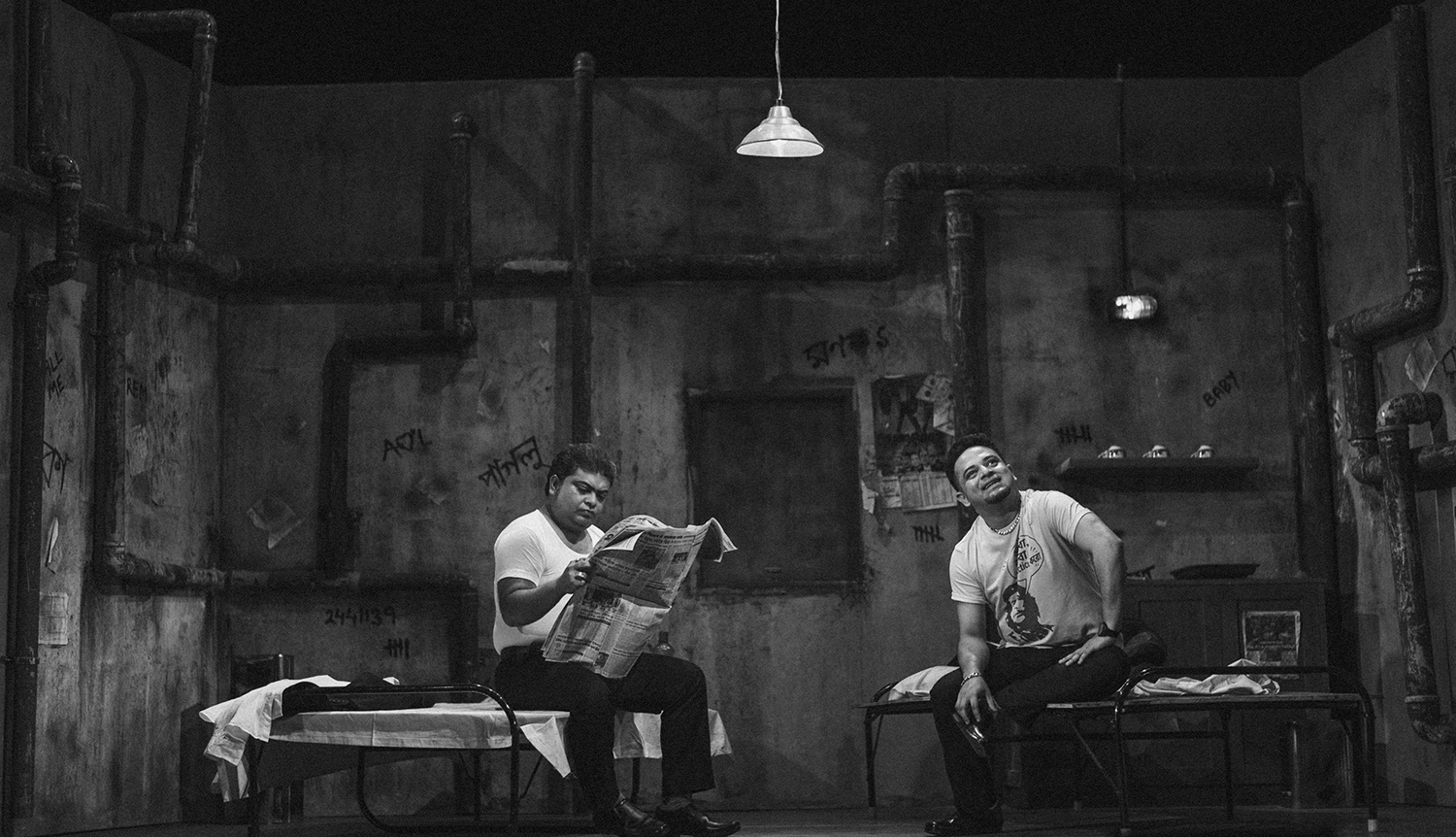 Despite titling his adaptation Bokā Bāksho, which obviously misleads viewers to expect something connected with the idiot box, Soumit Deb scripts a by-and-large faithful adaptation set in contemporary Kolkata of Pinter’s one-act about two hitmen awaiting instructions. Instead of the order to kill, they get slips for food orders via a dumb waiter, which they deduce come from an eatery upstairs. Cinebahini Troupe’s director (who remains unnamed) adds a third actor to mime the duo’s rehearsal of their PoA. And he concludes with an explicit shooting. Both these take away from Pinter’s fame for ambiguity.
But the production values are exemplary. One rarely encounters a well-constructed box set nowadays, in this case of the musty basement lined with drainpipes designed by Sarthak Pramanik. Sadhan Parui’s stark but few light sources enhance the effect, as does the variety of Abir Talukder’s realistic sound effects. Apratim Chatterjee and Satyam Bhattacharya (photo) balance each other perfectly, the former as the taciturn, experienced senior, the latter as the callow junior wanting some clarity, creating Pinter’s intended dark humour. To increase the runtime, they should focus more on Pinter’s infamous pauses that often convey his deeper meanings as well as tension.
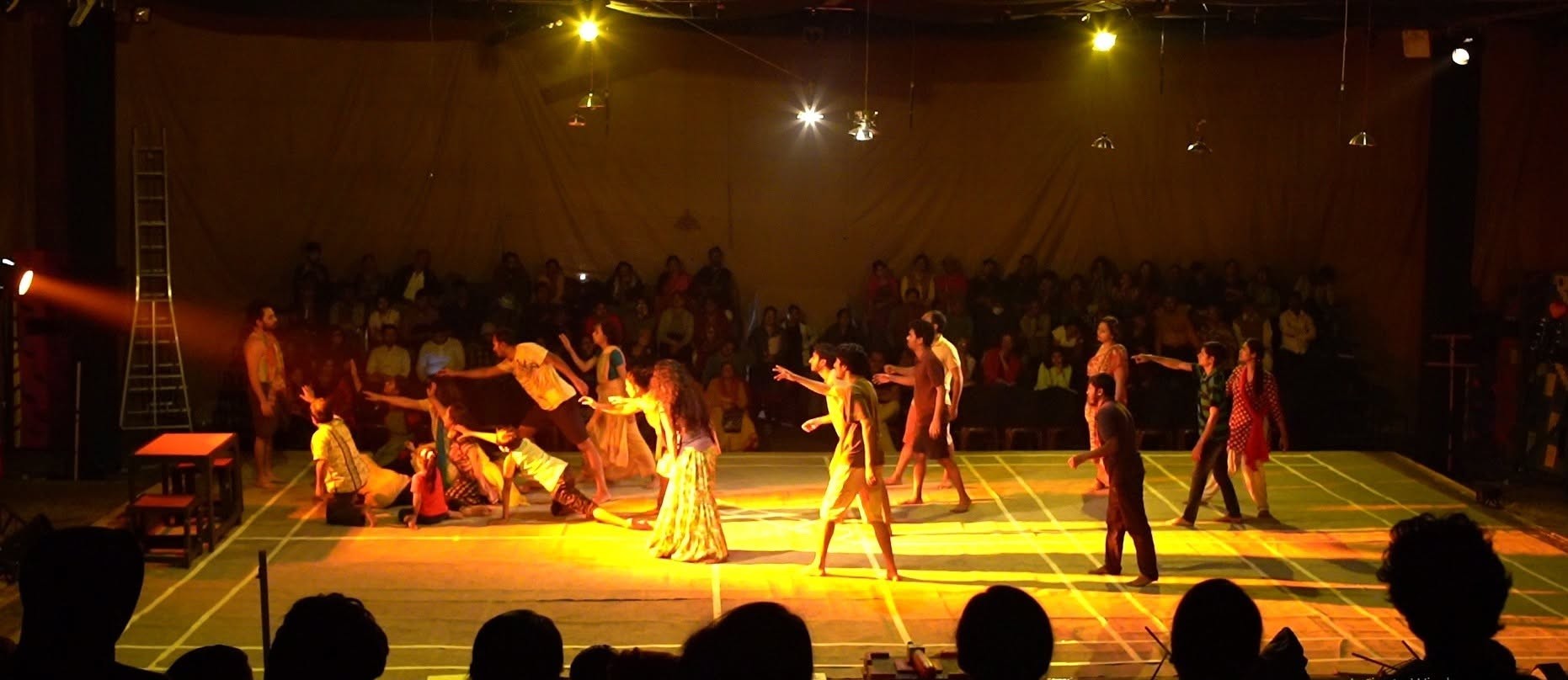 Trudging all the way to the Laha Colony playing field in Sobhabazar, I found that Kolkata Praxis had erected a novel temporary canopy inside which they had rigged an entire traverse theatre arrangement featuring the acting arena in the middle with two banks of spectators’ benches facing each other (photo). By the conservative standards of Bengali groups, it is a major structural and financial experiment. No wonder director Gautam Sarkar has adopted Maverick as his middle name. To match the grand architecture, he expanded his adaptation to over three hours and assembled a team of 40 for a workshop that culminated in Shandār.
Unfortunately, inspired to supply the rumbling of rhinos, the thunderstorm gods stopped me from witnessing it in full, for their massive downpour flooded the field, forcing Praxis to cancel the show. I could not make it to any of the later performances. But from what I saw, the cast successfully recreated Ionesco’s depiction of urban life through simultaneous staging and his typical intersecting conversations, while bringing in local scenic vignettes of the public, street vendors and TV news. However, the air-conditioning interfered with comprehension of the dialogues. Winter is the best season for such an intrepid enterprise.
(27 July 2026)