
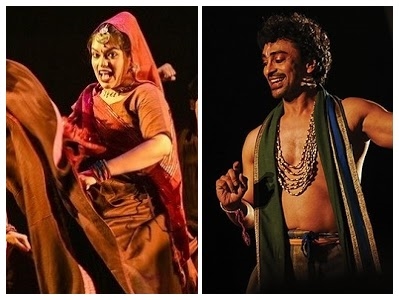
Flying under the radar to META 2025 in Delhi and surprising all by striking gold in nine of the 13 categories, these two Kolkata productions still don’t get enough bookings here, though they amply merit widespread visibility and appreciation. Both rework traditional sources, one from folk tale and the other from classical epic, one with a large ensemble and the other with a minimal cast.
The late Alakhnandan Sinha, better known by his first name, wrote and directed his most famous play, Chandā Bedni, for his own group in Bhopal, Nata Bundele, over 30 years ago. They had impressed the Kolkata audience in 2002 at Nandikar’s national festival. Mining Bundeli folklore, Alakhnandan dramatized the tragedy of Chanda, a member of the Bedni tribe, historically criminalized as prostitutes. A Brahmin youth, mesmerized by her dancing (similar to the real life of Padma Shri awardee Ram Sahay Panday, a Brahmin ostracized for popularizing the Bednis’ trademark Rai dance), proposes to her, which she laughs off, attaching tough conditions, but he accepts them all to join their community. Neither the Raja (also enamoured of Chanda) nor the Brahmins can countenance this inter-caste union, and some conspire to do away with her.
 Rangakarmee revives this, believing that nothing has changed, but then ends it on an oddly hopeful note. Importantly, though, they have rediscovered Usha Ganguli’s spark under her young disciple Anirudh Sarkar in his directorial debut—heart-warming for the continuity of this trailblazing troupe. He recreates Usha’s vision and method to calibrate a company of 30-plus into an awesome spectacle of teamwork, live singing and music, collective choreography (by Subhojiet Guha and Madhumita Chakraborty of the spinning Rai dance apparently named after how rāi, black mustard, seeds move in a bowl) and Badal Das’s energized lighting. The mostly new performers captivate, led by Ranjini Ghosh as a sassy and earthy Chanda (top photo, left), who speaks Bundeli as if born to it, dismisses her infatuated admirer as immature, but succumbs to his passionate devotion, and volunteers to take the test prescribed supposedly to free both of them. She has a super theatre future ahead.
The as-yet little-known Bengal Repertory have stormed into the spotlight with Nihsanga Ishwar, foregrounding another young talent, Suman Saha, as author-director-actor. Suman trained in the Nātyashāstra under Kolkata’s Sanskrit-theatre expert Piyal Bhattacharya, and brings that education in theory and practice into his Bengali text (co-scripted by Soham Gupta), modelled on the bhāna genre of monodrama, but dropping its satirical content and innovating the presence of a listener.
The writers zero in on Krishna’s solitary last hours in the forest, mistakenly shot by the hunter Jara, after the massacre of his entire clan in Dwaraka. As he lies dying, Krishna looks back at his whole life and questions his own divinity in the form of an onstage statue: was everything predestined or did he have any free will of choice? The Mahābhārata treats this episode briefly and matter-of-factly in its very slim 16th book, the Mausala Parva. Vyasa tells the confused, despondent Arjuna not to grieve for Krishna because his death was ordained as a result of the rishis’ curse, which the omnipotent Krishna could have overturned and thereby prevented the carnage, but chose not to. Suman and Soham may want to explore this point, and reduce the over-extended time they give to Krishna’s second thoughts about having deceived Jarasandha.
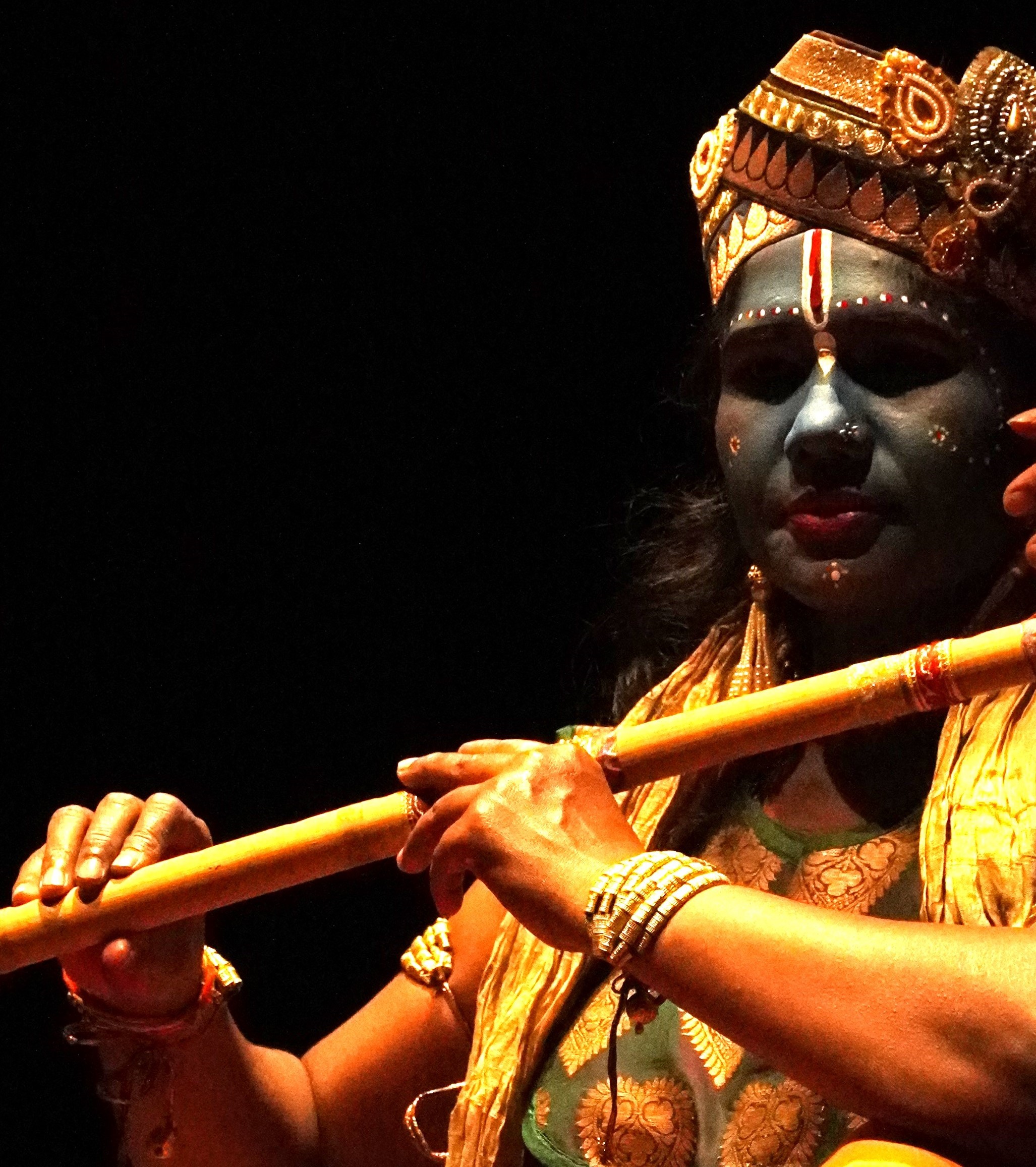 Suman’s performance (top photo, right) as the human Krishna is virtuosic, chatting directly to the audience, debating with his own idol, enacting various past events, and finally surrendering his body to the chant of Vāsansi jirnāni, therefore to reincarnation. With equal stamina, to stay in one position as the deity for 90 minutes, Chandrani Sarkar probably sets a record: the only stock-still precedents I can think of are Hermione in Shakespeare’s Winter’s Tale, which occurs only in its final scene, and Galatea only in the beginning of Gilbert’s Pygmalion and Galatea. What serves no purpose, however, is the screen hiding the accomplished musicians upstage; we should see them instead, as in traditional Indian forms. And amidst the beautifully sonorous dhrupadi accompaniment, the upstart harmonium sounds quite out of place.
25 May 2025