
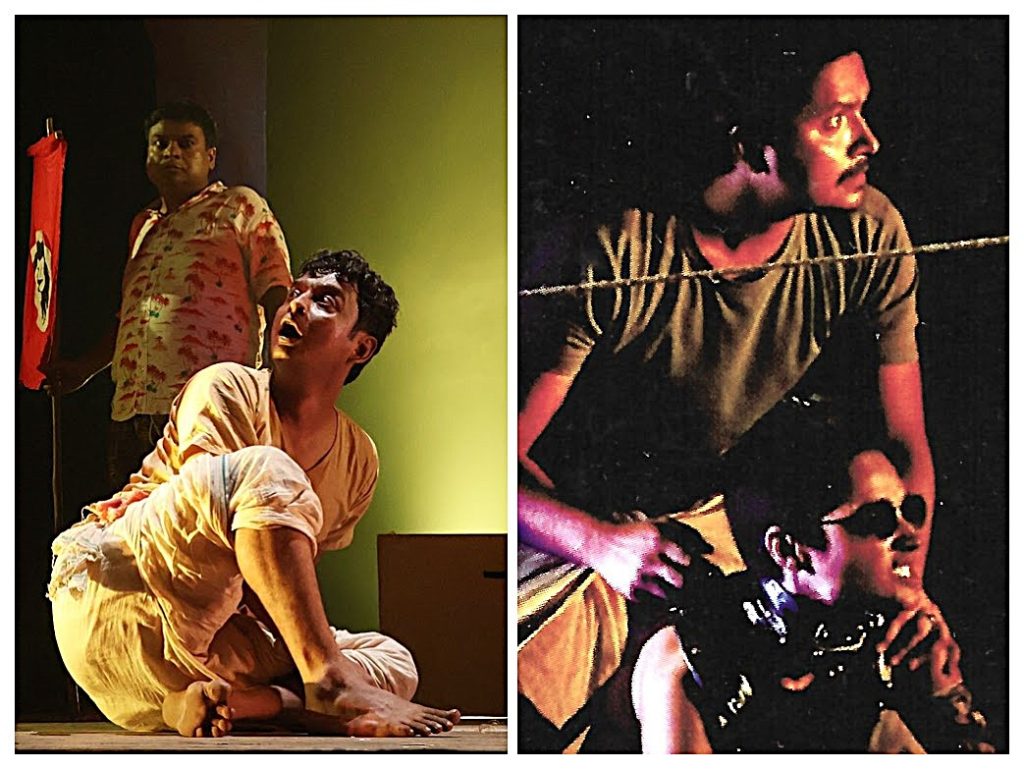
Fans of Shirshendu Mukhopadhyay’s paranormal Adbhuture series can look forward to a gala time at the theatre as two Bengali groups have dramatized two of these novellas rather well, and made them appealing to children and adults alike. The fact that both the guest directors rank among our most imaginative at present has definitely helped these productions, though their additions to Mukhopadhyay’s texts have differing results.
The older book, Gaurer Kabach, from the 1980s, receives rousing treatment from Suman Sengupta for Samstab, including a subtle political interpretation (that Mukhopadhyay surely never dreamt of!) playing on the name of the villainous Raghab Raja bent on taking over the village. The teenage Gaur, with aid from the centuries-old Kabiraj, fakir and thief, must thwart Raghab from grabbing Gaur’s forefathers’ magic amulet. Cheering them on are Gaur’s grandfather’s grandfather and the equally cadaverous Jogeshwar Baba, while his goonda brothers-in-law Hau, Mau and Khau throw in their lot with Raghab’s saffron brigade. Women didn’t find much space in the source, which Sengupta redresses by giving flesh and blood to Gaur’s sister-in-law in Amrita Mukhopadhyay’s distinctive bellicosity.
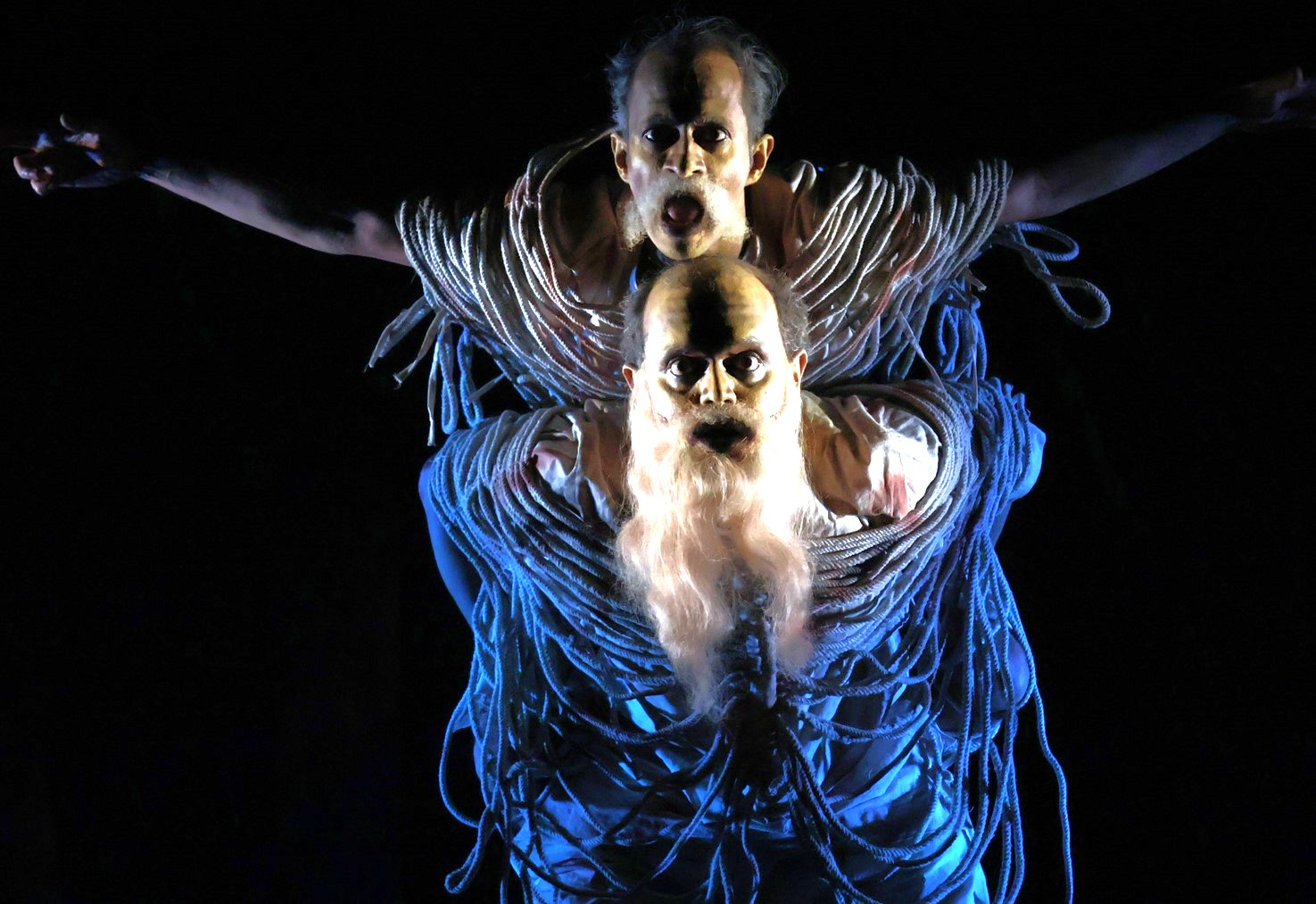 Tathagata Chaudhuri imparts the requisite good-naturedness to Gaur (top left) effortlessly, whereas Mayyukh Dutta’s imposing voice and height-plus-heels make Raghab a fearsome antagonist. Decked in Rushati Chowdhury’s innovatively-designed skeletal costumes and Surojit Paul’s deathly makeup, Susnato Bhattacherjee and Partha Sarathi Chandra create an unforgettable ancestor–ascetic duo (see photo above). Pinaki Mukherjee, Raju Mondal and Amitava Ghosh lend unexpected comic relief as the brothers-in-law in garish floral shirts. Abhyuday Dey’s live music lifts the performance (clocking over two hours, therefore marginally long for young viewers) at appropriate moments.
Kuntal Mukhopadhyay dramatized the recent novella Ek Āshcharja Pheriwālā into Sanglap Kolkata’s Hulusthul. Shirshendu’s recurrent conflict of good vs evil remains, along with his timeless benevolent characters, in this case the titular vendor who peddles apparently worthless items like soundless whistles and lightless torches, against a ruthless corporate mafia determined to get hold of these actually powerful scientific inventions. However, the extraneous interpolations—a shady bar featuring young women, a romantic subplot—seem to target a mature audience and do not further the original purpose, whereas we can justify the insertion of the retired scientist Gajapati’s stint in the loony bin as arising from the source. Of course, Kuntal keeps the vendor Kalicharan’s most telling comment towards the end, that in the future when men no longer use weapons, they can display as an exhibit the gun meant to kill him, to show how violent men once were.
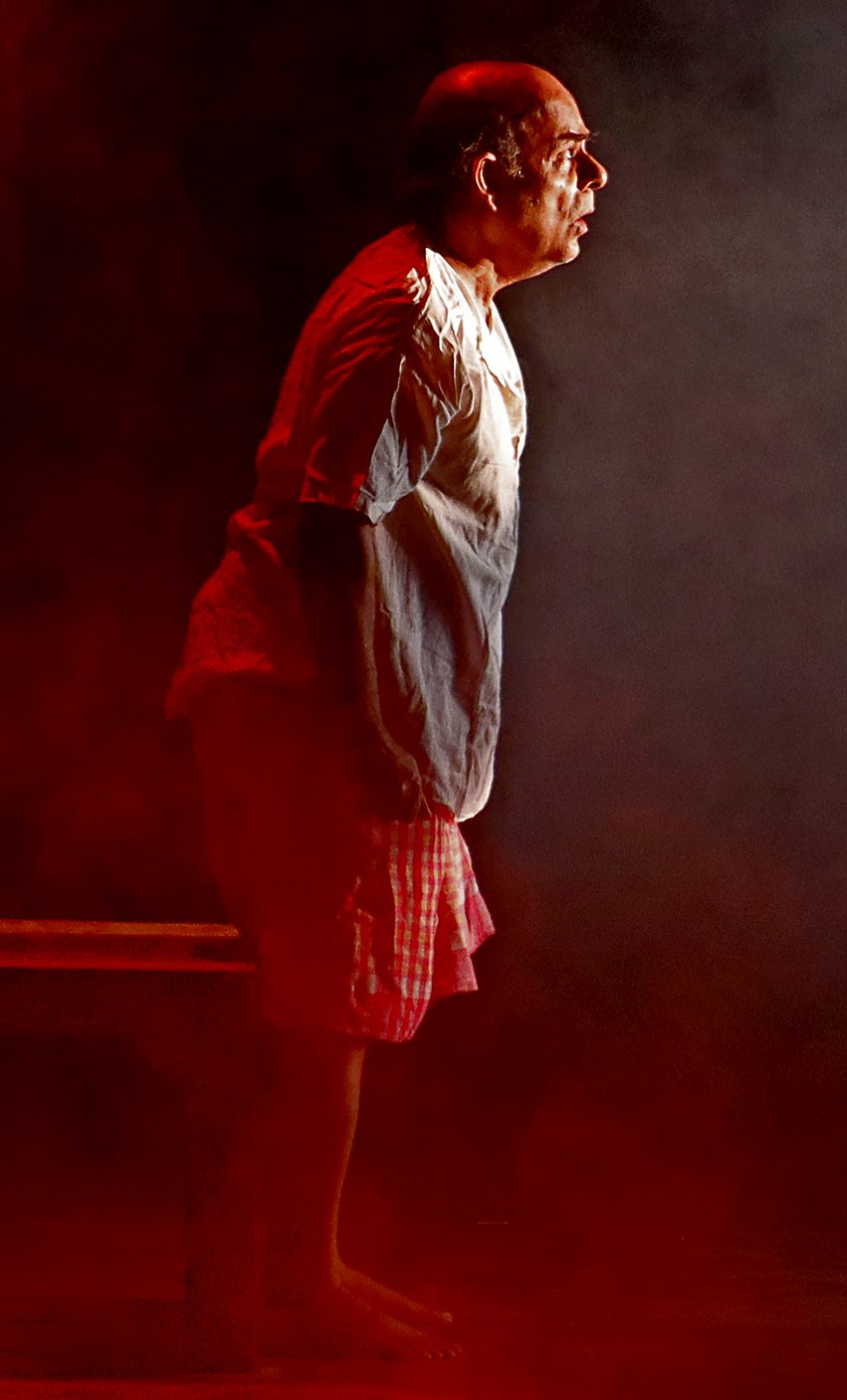 Bitanbindu Bandyopadhyay’s portrayal of the eccentric Gajapati (photo alongside) fixated on hybridizing a black hibiscus confirms his position as Sanglap’s finest but under-recognized actor, here evoking shades of the inimitable Satya Bandopadhyay. Kaushik Ray brings more direct laughter as Gajapati’s mischief-making house help. Dhrubo Mukherjee acts Kalicharan (top right, with his dog) realistically rather than mysteriously, and Soumen Chakraborty makes the hitman Shadow an even more gritty depiction of desperation in dire domestic straits. Debasish’s direction bears his trademark touches—a mid-backcloth cut out with passageways upstage, acoustic music, inventive use of chairs to imitate a train running on tracks—but visible stagehands behind set pieces of trees looks amateurish, and Shadow tossing a teacup into the wings flouts environmental consciousness.
31 March 2025