
The Urban Theatre Project TUTP), now just over a year old, has become a nucleus for solo or minimalistic performance in a studio setting, serving both local and touring productions. Most so far have not dialogued with its odd-shaped yet flexible space, and instead implemented a conservative stage–auditorium default layout facing each other. Notably exceptional was Kheyechish? (strictly transliterated as Kheyechhish) by Mumbai-based Meghna Roy Choudhury, who sat spectators on three sides of her and carved a walkway to her left, allowing her to foray into them heightening the intimacy.
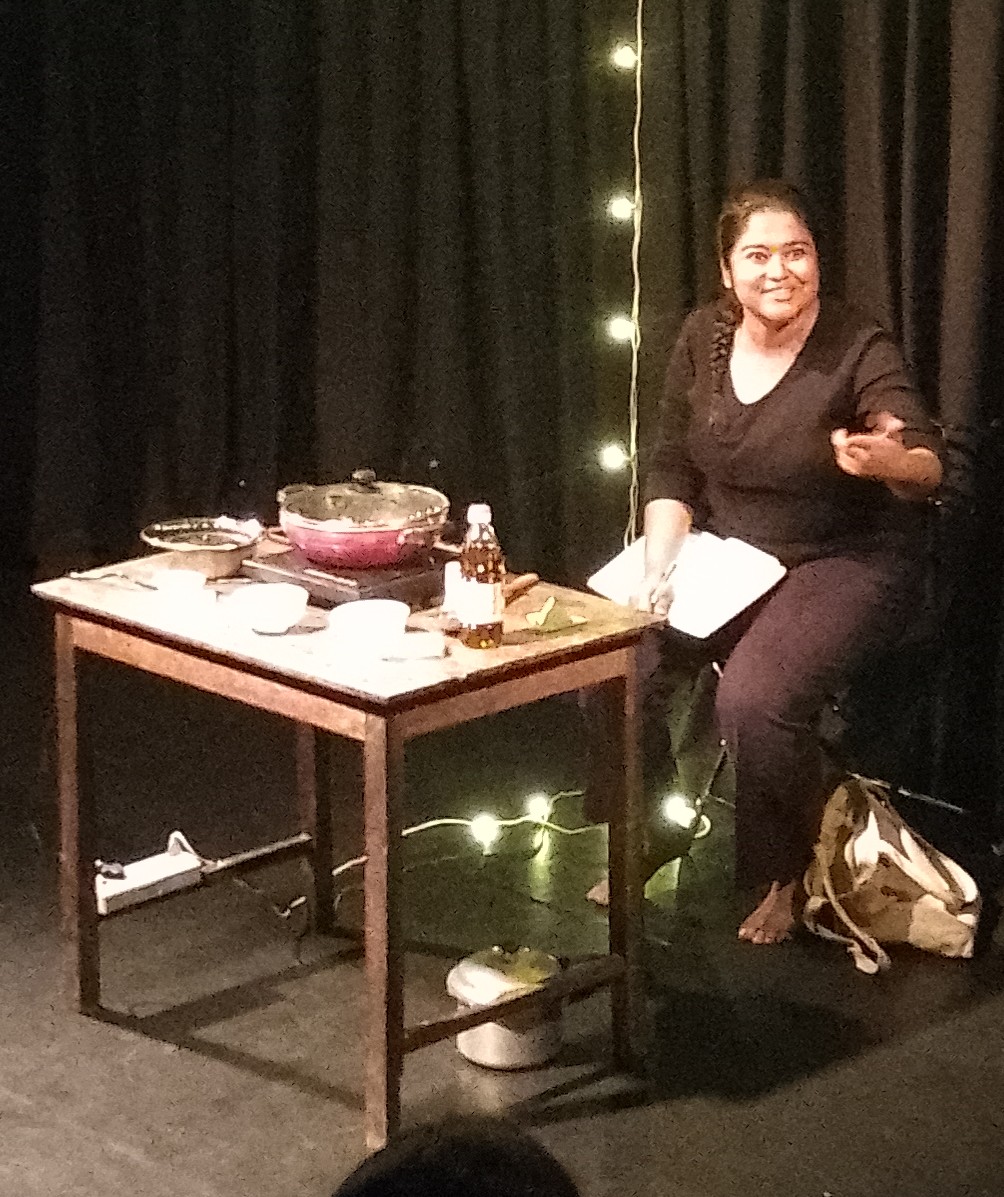 Her well-written Hindi-English-Bengali text, narrating the daily routine (read ordeals) of a part-time drama teacher in Mumbai whose mother phones regularly from Kolkata asking among other concerns the titular question, also goes back to their family history of migration- and hunger-related hardship. Kheyechish? thus falls under the new rubric of auto-ethnography, which we have seen by equally young and trained soloists like Ahon Gooptu and Ruhani Singh. But self-reflexivity risks and often lapses into self-indulgence, which Roy Choudhury overcomes with panache, speaking (though not at all obviously) for all Indian youth living singly, working away from their comforting homes. Her palpable honesty liberally spiced with humour make all the difference, expressing a vulnerability that is universal and a resilient spirit. Alongside, she presents ironically the Indian condescension to theatre education.
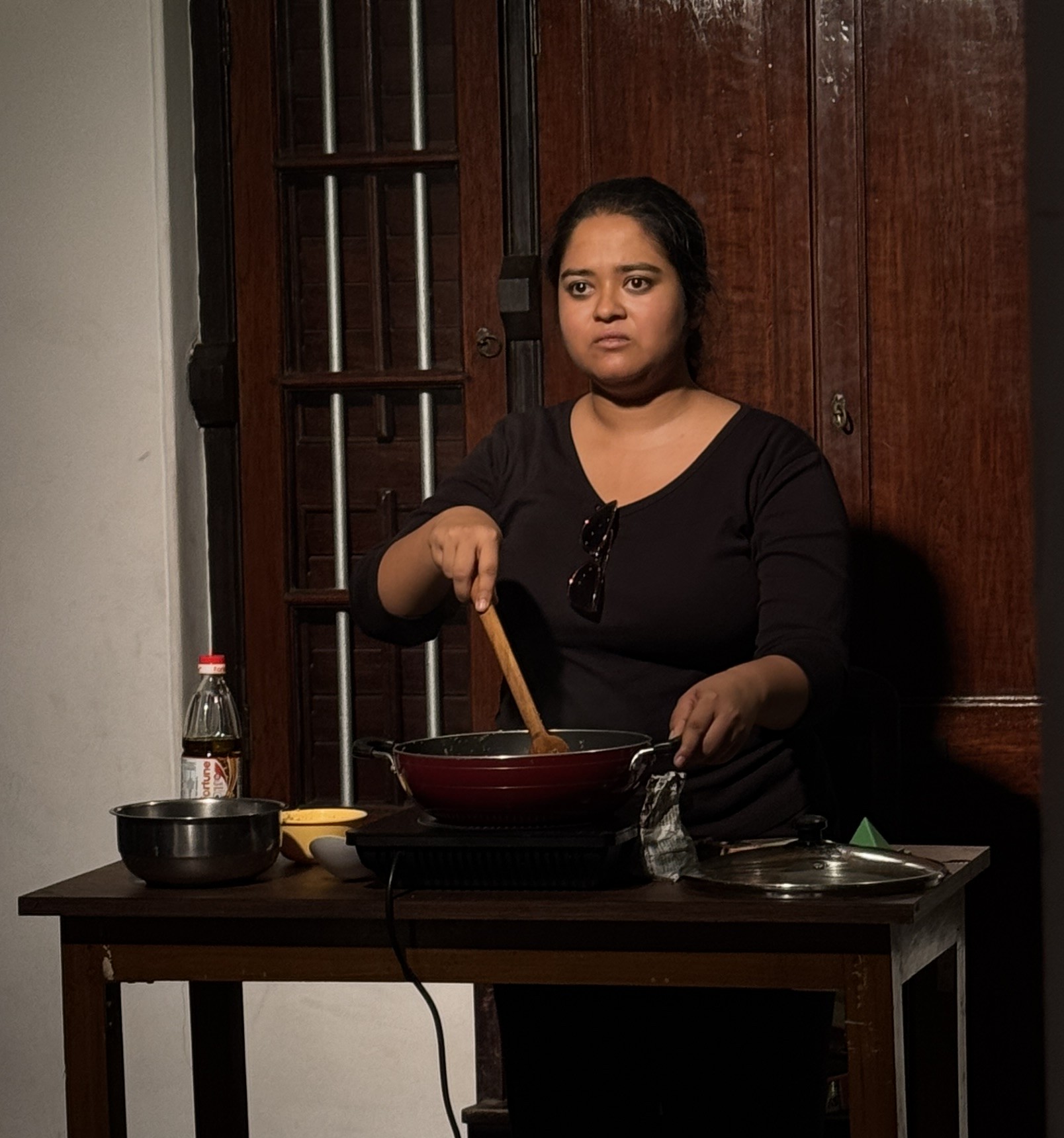 She begins with shopping for groceries (inspired by Brecht’s poem “The Shopper”) and ends by cooking ālu posto and phen bhāt on her hotplate following her mother’s recipes. The dishes, which she invites viewers to share, carry grim associations of the Bengal Famine and starving refugees—her grandparents’ burden of memories, suggested but never in-our-face. Her evident homesickness gets magnified by her invisible mother’s repetitious calls that simultaneously irritate and solace her. Dhanesh Gopalakrishnan, voicing several other people irrespective of gender, adds depth to the drama. I observe happily that, unlike most Indian theatricians who require one desperately, Roy Choudhury credits the inputs of a dramaturg, Siddhesh Purkar—whom I can therefore criticize for a few mispronunciations (inexcusable for a teacher!) like fam-ayn for “famine”. I hope Kheyechish? returns to feast more theatre gourmets here.
Other independents, too, have not named their group—though I rather like the moniker on their tickets, “A Revolutionary Anarchist’s Circus”—which performed dramatist-director Sourav R. Nath’s Nothing like Persepolis. Unlike revolutionaries and anarchists, however, they placed themselves safely at one end of TUTP and never disrupted the fourth wall. Also, they seemed heavily influenced by Soky’s Norwegian clown workshop and process at TUTP in November, starting as they did with an unrelated item number, then adopting clownship for Nath’s scenario on women and war alluding to Marjane Satrapi and Macbeth. As three female jesters, Mouktika, Srishti and Swastika certainly broke the glass ceiling, on the other hand prophesying mayhem like Shakespeare’s Witches. Next time, they need a stronger script to play with, greater parity in individual levels of performance (one or two conspicuously superior at present) and like many next-gen actors, correct diction (mar-tears marring “martyrs” being one example). As director, Nath must realize that a circus only looks chaotic but actually demands great rigour and precision, less improvisation.
(27 January 2026)