
Two groups revisit European drama with political underpinnings from the 1950s for new adaptations. Despite the strong leftist ideology of Bengali theatre, it has not noticed that Dario Fo’s centenary falls this year. So far, only Ganakrishti celebrates the occasion with Amitava Dutta’s Māstuto Vice, reviving one of Fo’s earliest comedies, The Virtuous Burglar, ingeniously punning on the Bengali proverb “Chore chore māstuto bhāi”.
However, Dutta downplays Fo’s politics, which clearly indicates that the lower-class thief is more virtuous than the upper-class couples cheating on one another. Fo specifies a “luxury” apartment, so Dutta must upscale his set, costumes and rather dim lights accordingly. To maintain Fo’s farcical spirit, he must speed up the slack pace at the start, and figure out a way by which the clock’s hands can move back and forth, possibly with one crew member dedicated to it and positioned behind it the clock. 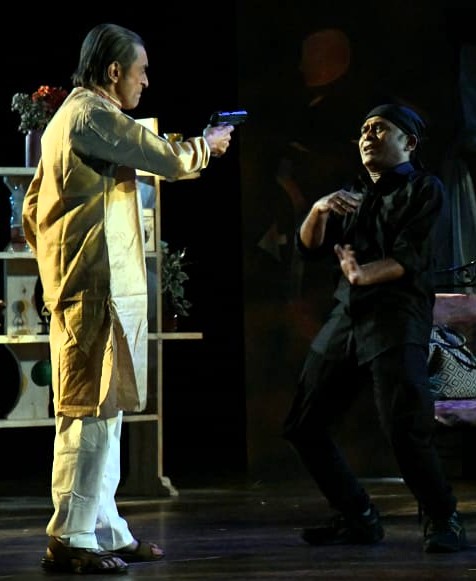
The performances require no improvement—Subhasish Mukherjee super in a rare comedic caught-red-handed role desperate enough to kill (photo, with Dipak Das), Soma Dutta as his nervous paramour, Dipak Das (the befuddled burglar) and Lopamudra Lahiri (his loud, jealous wife). Juin Bagchi and director Amitava Dutta complete the merry-go-round as the other illicit pair.
Max Frisch’s The Arsonists (previously Englished as The Fire Raisers and The Firebugs) has had many incarnations on the Kolkata stage, and fascinates dramatist Anirban Sen so much that even though his group Paramik produced it two years ago as Chakrānta (see my review), he reworks it as Rupāntar and has it directed again by his comrade-in-arms Suvojit Bandopadhyay.
The ambivalence in Frisch’s absurdist classic allows polarized interpretations. Sen presents it as the defunct idealism of Communist parties and throws up more questions than he solves. He criticizes turncoat politics and goonda politics, and wistfully wishes to rally Communists together. Thus, his protagonist becomes a disaffected party worker rather than an arsonist, lobbying people from door to door, and his antagonist is the state’s Home Secretary rather than a bourgeois businessman. We can draw our own conclusions, but Frisch’s anti-fascism does not figure.
Bandopadhyay enacts the lead himself as a reflective revolutionary, while Bratin Gangopadhyay and Swagata Sen perform the couple in power credibly, she more sympathetic to the left than him. But Bandopadhyay neglects direction, since he repeats the scenographic concept of Chakrānta and adopts recent Bengali-theatre clichés like umbrellas and bicycles. He must also answer to the now-indefensible act of smoking on stage.
(25 June 2026)