
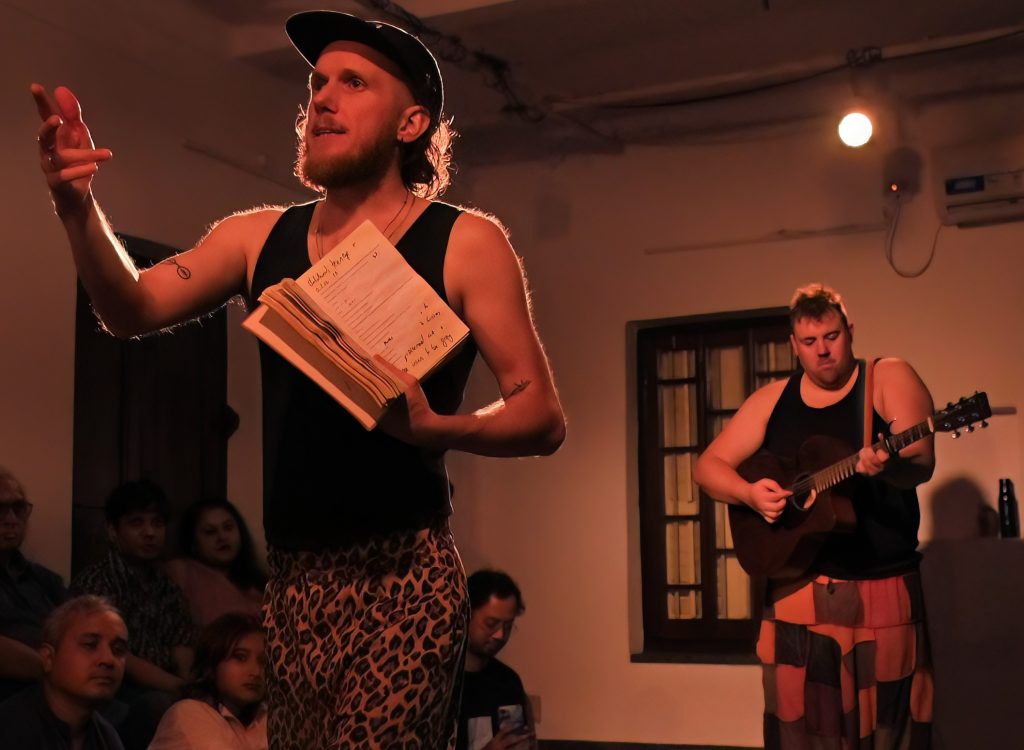
Wright&Grainger (indeed spelt without spaces, possibly declaring that they work as one) brought a zephyr of fresh air into Kolkata’s crusty performing-arts edifice. Although not “strict” theatre, their hour+ gigs hosted by The Urban Theatre Project reinvented spoken-word storytelling with songs on Orpheus (2016) and gave a mostly young audience the taste of a rock-opera-like 12-track album delivered live on The Gods The Gods The Gods (2020). Both should inspire our musically talented listeners to experiment in similar ways.
The duo constitutes a perfect partnership of equals. Alexander Wright writes their narratives mostly in verse (a poet and he knows it), often in long rhyming couplets hip-hop style, and raps them out in rhythmic ripping rat-a-tat (which occasionally made it difficult for us to follow the words, given his Northern English). Phil Grainger composes the music and sings the lyrical songs in a melodious voice, accompanying himself on guitar. On The Gods, Casey Andrews provided vocal support, offering the necessary variety to suggest different characters; appropriately, the soundscape here had a wider range from introspective ballads to thumping electronica, to fit the scenes or personae.
Wright situates Orpheus in a British pub/bar where Dave, who sang to plants as a boy but lost his sense of colour since, meets Eurydice and sees colours again—making it relatable to Gen Z, most of whom have no knowledge of the myth. While Dave’s tentative karaoke “Dancing in the Dark” marked a high point, W&G’s palpable sincerity communicated the deepest, implanting the hope that grows out of true love in a greyscale generation that may have become cynical and frustrated by the state of the world. Eurydice’s connection with nature also moved us, as Dave finds her every springtime when leaves sprout again, symbolizing the earth’s regeneration. We await eagerly their companion piece, Eurydice.
The choice of a traverse seating, the audience on opposite sides of a central pathway up and down which W&G performed, was innovative for Orpheus (photo on top). But the venue for The Gods was completely unprecedented: the lower deck of The Bengal Paddle, India’s last paddle steamer, which sailed into the Hugli imperceptibly as the music pounded. A memorable immersive experience that stopped short of Puja immersion in the river! Ninad Samaddar of TUTP deserves a standing ovation for this brainwave through placid waves. Wright, Grainger and Andrews occupied three platforms at the angles of a triangle, in the middle of which the crowd stood and danced (in the photo below, they came together at the finale).
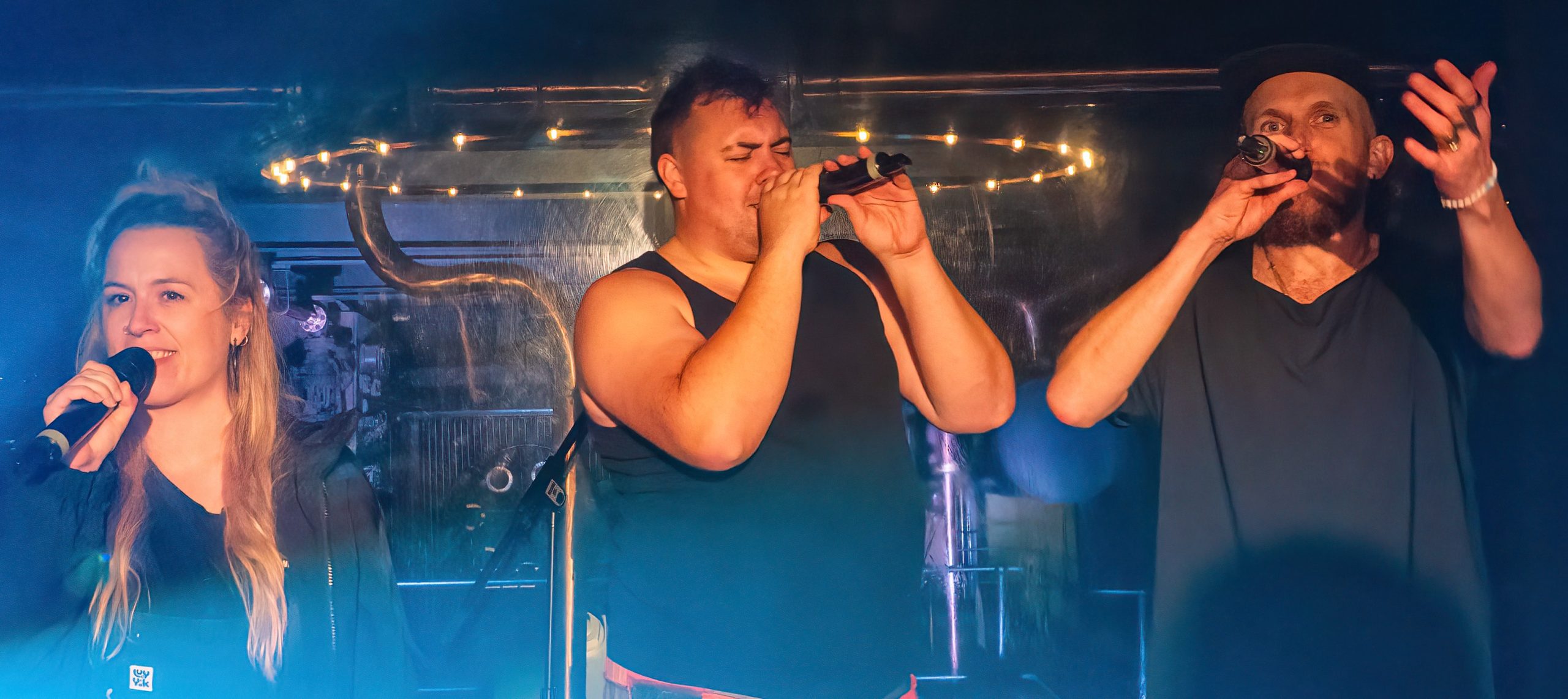
The Gods told four stories: the divinities at a caff, decidedly more worried and benign (especially Zeus) than the Greek pantheon we know; two lovers who have lost their spark; a woman carrying the urn with the ashes of her partner; and a man on a bridge ready to jump (no, the barge did not go under Howrah Bridge). You guessed it, the theme is death, but it seems W&G’s general agenda is to spread light amidst our human darkness, and so the album concludes by identifying the god within each one of us who guides us even if no one else does.
(5 November 2026)