
Minerva Natya Sanskriti Charcha Kendra’s national theatre festival could transform the scenario of such festivals in Kolkata, if only the organizers put some intelligence into their efforts. As I’ve mentioned before, to have different productions on at the same time in two venues means that spectators must choose between them even though they may want to see both. This year’s seventh edition brought ten plays from outside, but any one person could catch a maximum of seven because of this brainless scheduling. Besides quantity, we have a problem of quality, which most of the guests lacked. It appears the new vice of reciprocal invitations, whereby you call the groups who call you, vitiates the selection.
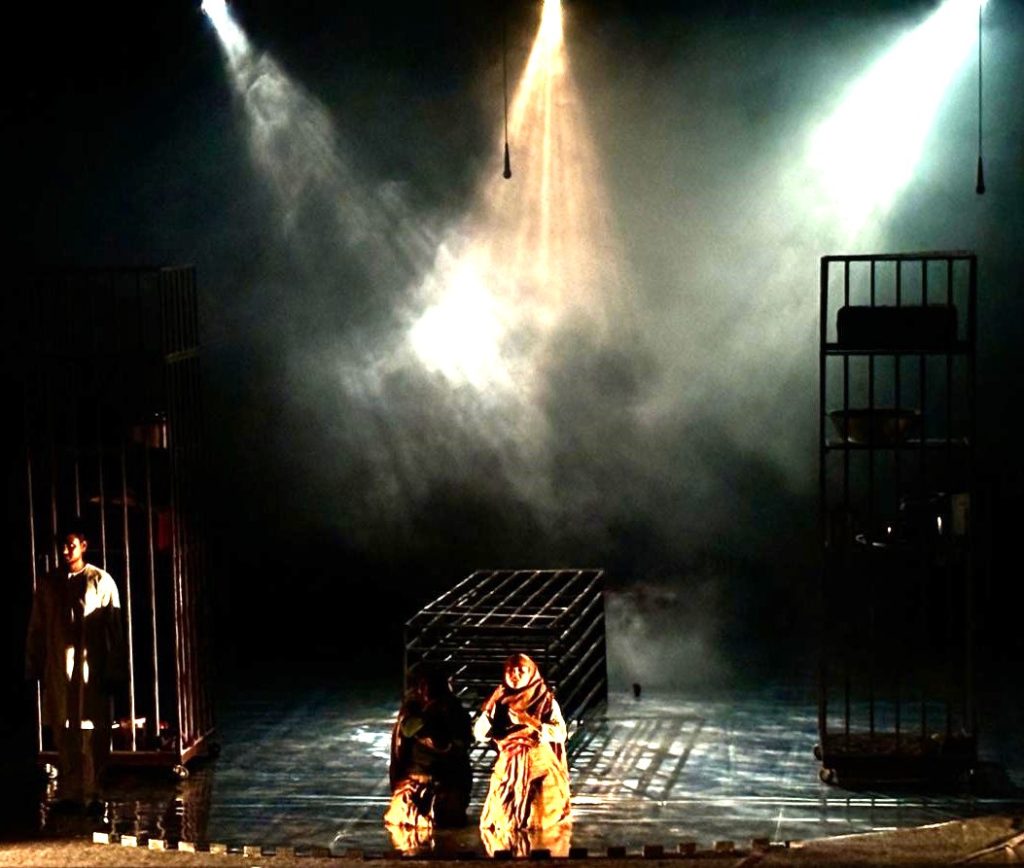
Consequently, the only production worth seeing that I saw was Raaga Repertory (Patna)’s Small Town Zindagi, dramatized from Hrishikesh Sulabh’s huge novel, Dātā Pir, by Krishna Samiddha. It presents the futile struggles of a Muslim family of gravediggers in a Patna cemetery to emerge from their wretched life. The mother, daughter and son fail to break out, while another daughter escapes and is not heard of after a while. Randhir Kumar and Samiddha co-direct the actors in intense performances, and construct imaginative visuals with three tall cages symbolizing their separate spaces as well as entrapment (photo), the Pir on a platform—all on coasters for easy rearrangement—and dress changes in full view on stage.
In the awed silence before the curtain call, Minerva’s emcee in her inimitable style called on “Ms Samiddha” repeatedly to come up, despite him having already done so and looking visibly masculine. He laughed along, genially accepting the female status conferred on him. So much for Minerva’s homework.
From the perspective of reviving old drama, North East Theatre Academy (Golaghat) shed light on a previously unexplored aspect of Jyoti Prasad Agarwala, the father figure of Assamese theatre: that in Rupālim (1937), he foregrounded a non-Hindu tribal community as well as the rulers’ oppression of their own subjects. However, Simanta Phukan takes some very poor directorial decisions. He gives the tragedy a happy ending, keeping the eponymous heroine alive, denying Agarwala’s intention. He shortens the length, thereby denying its cumulative impact. He goes overboard with spectacular musical and lighting effects. And ignoring our present imperative to save tigers, he retains the episode where Mayab’o kills a tiger to prove his heroism, instead of replacing it with something else. Among the cast, Snigdha Sikha Saikia impresses as the complex princess Itibhen.
Unicorn Actors Studio (Delhi, not Mumbai, Minerva kindly note) brought dramatist-director Happy Ranajit’s Bloody Bombay, about hopeful actors from Delhi gravitating to the film capital like moths to a flame and getting burnt in the process. Undoubtedly true, and we sympathize entirely, but it is nothing new, having happened for decades, and staged by others like Ekjute’s Yeh Hai Bombay Meri Jān. Ranajit needs a deep text, not a series of incidents strung together for his admittedly talented team to improvise on and show how tinsel dreams die. Kolkata audiences have witnessed a much more sophisticated recent theatricalization of this phenomenon in Debasish’s Rāvan Reloaded. I wonder whether Debasish saw Bloody Bombay earlier and figured he could do a superior job.
The most ridiculous play—winner of a Mohan Rakesh Award, no less—was Rangsaaz (Noida)’s Chauthi Cigarette. Yogesh Tripathi’s premise of two former college mates, one a financially insecure Bengali columnist and the other a successful businessman who wants the fame of an author and pays the former to publish his novel under the latter’s name, bears faint echoes of Girish Karnad’s Broken Images, including video interviews after the novel wins a Booker, of all prizes! Neither Tripathi nor director Danish Iqbal seems to know or care that the Booker goes to books in English (which the said writer has no fluency in) and that, even if in English translation, it takes considerably long to translate a novel (unless you are India’s most prolific translator, who churns out necessarily flawed translations in next to no time).
31 January 2025