
To my pleasant surprise, the National Theatre Festival 2026 organized by Minerva Natya Sanskriti Charcha Kendra, criticized by me for its arbitrary selection in past years, exhibited some thoughtful curating in inviting productions from beyond Bengal this time, particularly the trio from Maharashtra that I saw at Madhusudan Mancha. They provided an insightful look at the next generation of theatre in that state outside Mumbai.
Choosing a text that speaks to us with immediacy is the vital first step, which Pune’s Social Manch and Peace Projects ensured: Shanta Gokhale’s Truth and Justice, an outspoken interrogation of curbing free speech and of that fashionable term today, post-truth. Perhaps prompted by her experience as a dedicated journalist, Gokhale wrote four women’s monologues located in history: two on the infamous “Dreyfus affair” for treason in 19th-century France, including Zola’s imprisonment for libel; a teenager jailed for perjury in a thinly-disguised “Famous Bakery” case on the Gujarat riots in 2002; and the 2009 killing of Sri Lankan journo Lasantha Wickrematunge for exposing genocide of Tamils during the civil war there. Without any sensationalizing, Gokhale presents violence and resistance, and questions by analogy the state of our pillars of democracy—legislature, executive, judiciary, media.
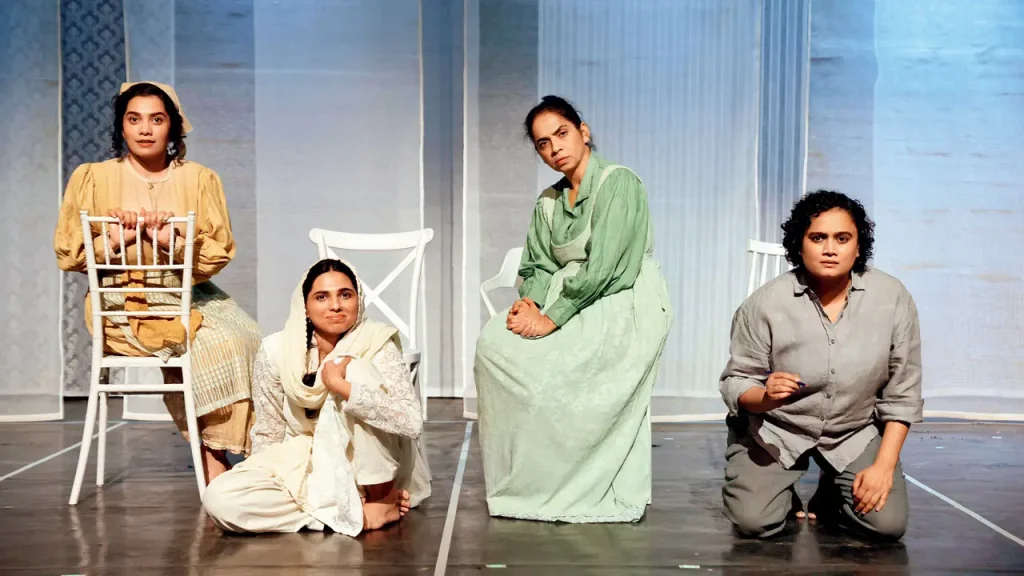
This daunting task in our imperilled times does not cause debutante director Parna Pethe to flinch. Her English–Hindi interpretation, Something Like Truth …, appropriately employs stark white panels, in front of which the four actresses (photo)—Sharvari Deshpande as the cleaning lady (chair, left) and Ashwini Giri as Mrs Dreyfus (chair, right), Dusha as the Gujarati Muslim (floor, left), and Kalyanee Mulay as a reporter today (floor, right)—deliver moving yet restrained witness testimonials, while stylizing them collectively through choreography and song. Aabha Soumitra’s atmospheric live music buoys the tone, but why hidden in the wings? Pethe directs everything with refinement, down to the tiny folded-in souvenir.
Another young group from Pune, Paradigm Shift Arts, staged a novel Hindi–Bengali play on Tagore’s sister-in-law Kadambari Devi—mostly unknown to non-Bengalis, so dramatist-director Meghna Roy Choudhury explains the context of their friendship in greater detail than required for Bengalis, even listing a formidable bibliography of sources in the handout. She paints a delicate theatrical canvas, never stooping to typically lurid speculation about their relationship or Kadambari’s suicide. Their closeness from childhood through their teens to her death aged 25, spanning 16 years, comes alive impressionistically, interspersed with snippets from Tagore’s later fiction, of Charulata (Nashtanir), Mrinal (“Strir Patra”) and Bimala (Ghare-bāire) manifesting his reincarnations of her caged personality. The scenes of his playful nicknaming her as Hecate and their togetherness on the Jorasanko rooftop at sunset linger in the mind, as directed by Roy Choudhury.
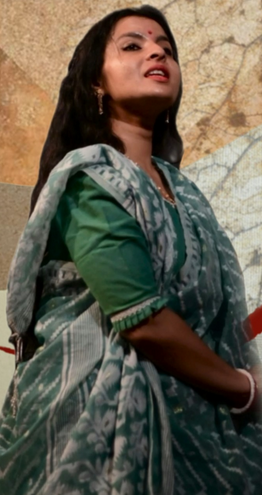 Ravi Choudhary’s symbolic scenography suits the subtly interwoven threads: an antique four-poster bed for the domestic interior, a huge chest from which emerge characters like Charu to suggest the treasure trove stored in Tagore’s heart, and a projected backdrop of leafless trees signifying Kadambari’s tragically cut-short talents. Ipshita Chakraborty Singh shines as a charismatic but confined heroine (photo), while Priyanka Choudhary complements her as Tagore’s literary creations, her amazingly puppet-like rise from inside the chest expressing the patriarchal and authorial manipulations of women. The weak links are the male actors speaking poor Bengali and singing off-key, which grate in contrast to Chakraborty Singh’s perfect diction. Roy Choudhury should let them use Hindi, since the dialogue is bilingual anyway.
Moving to Nashik and another historically-based work, the Sachin Shinde Academy of Performing Arts revives a Marathi folksong tradition, Kalgitura, seven centuries old but now fighting against declining interest. Datta Patil wrote the play, set in a village near Nashik and fictionalizing a situation where the local Kalgitura troupe lies in the doldrums, followed by the death of their last senior artiste. A chance discovery of handwritten lyrics leads to a concerted effort to reconstruct the form, ending in hope for the future.
Kalgitura takes place mostly as competitive question-and-answer duets between devotees of Shakti and Shiva, referencing myths and concluding in a happy joining of bands. But it also occurs as part of mourning rites through the night when someone in the community dies. The star of the production is the music, reinvented by Rushikesh Shelar and the ensemble of singers and accompanists whose rousing renditions brought the house down under Sachin Shinde’s direction. Kalgiturā offers a model for similar projects to spotlight and resurrect the hundreds of endangered rural Indian forms rapidly losing out to the screen—now no longer the big variety, but small and smartphone.
(9 February 2026)