
Happily for Bengali theatre, I can announce the presence of a new, original dramatist-director, Gaurav Das, who founded Santoshpur Anuchintan with its own studio space, and has now created full-length productions displaying depth of research and inventive vision, exploring overlooked and threatened folk traditions in his two latest projects.
He had first conceptualized Debi Sitalār Sandhāne under the title In Search of Goddess Sitala for Goethe-Institut and Sandbox Collective (Bengaluru) as fieldwork into Sitala Jatra, excavating oral narratives and textual sources like Dwija Nityananda’s Sitalā Mangal and the Skanda Purāna, rediscovering for us the myths behind the localized, non-Hindu cult that established Sitala in the divine pantheon, analogous to Manasa. But Das does not confine himself to ritual anthropology; as has become his playwriting trademark, he complicates the theme with metatheatre and sociology: he parallels the near-extinction of Sitala Jatra with that of female impersonation, and brings in homophobia and transphobia. However, though groups have not foregrounded Sitala since Chapal Bhaduri’s Ekmukhi Sitalā in 1999, the graphic subplot of exploitation and rape in village opera troupes has recent precedents.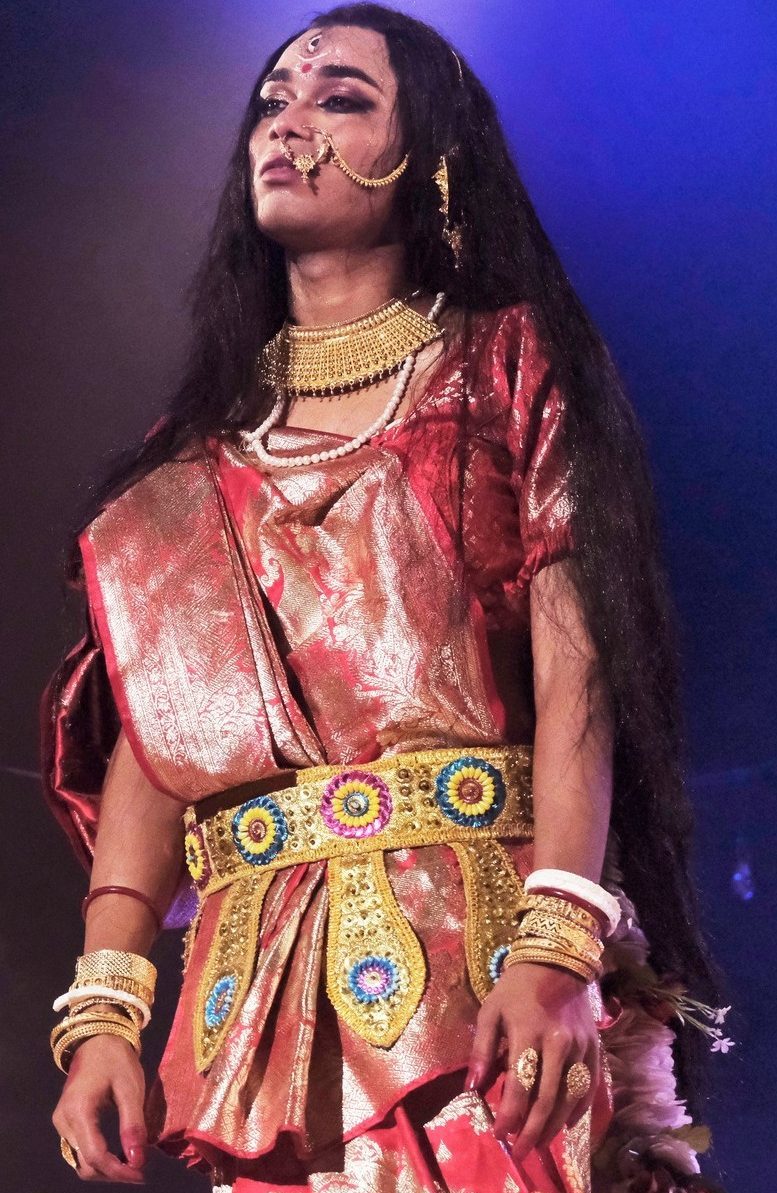
Anuchintan should take pride in the mettle of its performers, trained by Das, particularly Nayan Sadhak’s pristine acting and singing as the youth playing the goddess (photo to the right), and Chakropani Dev, lead vocalist in the chorus. Some unusual scenes remain in the memory like the life-like donkey moving with Sitala astride, and Arpan Sarkar’s filmed sequences shot in the countryside, edited expertly to merge with the episodes on stage.
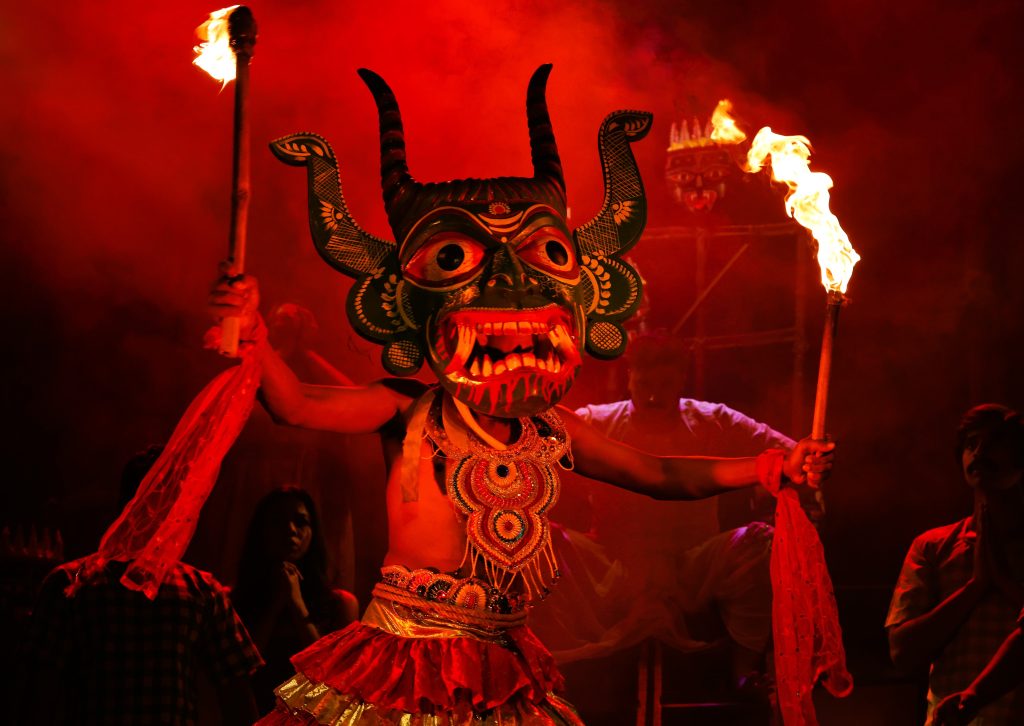
Das tops this with Ānginā Jure Bhor for Aneek, bringing before us a form that Kolkata has rarely seen, if ever: the Gomira dances of Dinajpur, related to but distinct from the more familiar Gambhira of Malda. He connects the Srimati river in Dinajpur, dried up after the Tista dam, with the endangered Gomira. He educates us with excerpts from their Rām Banabās Pālā, a scripted drama within the genre that Muslims perform. The wooden and papier-mache masks startle with larger-than-life supernaturalism (photo on top).
His tragedy outdoes Debi Sitalār Sandhāne in its almost epic (in the structural sense) intricacy, traversing time and place. The scion of a Gomira family seeks greener pastures at a commercial playhouse in Kolkata, setting up a village vs city conflict, as well as two contrary forms, the performative rural against the performatory urban. Cleverly, Das unites them as the Kolkata company stages a play on Sita, while a test by fire becomes a common motif in both the theatre and “reality”. He tells me that he moulded the protagonist Jaydeb after a historical person, then took off on a fictitious trajectory; but Ānginā also belongs to a recent spurt of good Bengali drama on the downfall of professional halls. Das introduces multiple love stories, involving rejected women and sex workers-turned-star actresses. In the coup de grace, the Muslim scholar who begins the play comes full circle at the end, an unstated link to the faith of Rām Banabās actors.
The multiplicity has its drawbacks, bursting at the seams to near-breaking point. Das can cut this surplus with several measures: remove Jaydeb’s initial resistance to an interview before his quick consent; curb melodramatic climaxes that go way overboard in indoor (rather than outdoor) venues; and critically prune regressive superstitions and rituals arising from irrationality and violence.
His large team commands exemplary dynamism, particularly Bhaskar Banik and Arup Roy as the younger and older Jaydeb, Avinandana Dey as Jaydeb’s love at home significantly named Srimati, and Samriddhi Banerjee as the leading lady full of herself. The costumes designed by Nayan Sadhak are meticulously accurate, specially the pātāni saris worn in distinctive Dinajpur style. Unfortunately, the lighting did not extend to the backcloth, which stayeed in the dark.
Ānginā Jure Bhor rightfully featured among the five productions chosen by Bharat Rang Mahotsav for its Kolkata leg this year, the first time that the National School of Drama included our metropolis in its mega-circuit. However, four of the five originated from Kolkata, which made no sense whatsoever—why would anyone go to the self-proclaimed “world’s largest international theatre festival” to see local plays that anyway get shows here? The point of such an event should be to import productions into cities that normally can’t catch them. For the record, I have already reviewed two out of the four (Offbeat’s Rakta-karabi and Samstab’s Gaurer Kabach).
The one that I hadn’t seen, Sangshaptak’s Dānā, written and directed by Kaushik Chatterjee, presents the drudgery of an ordinary man, a dreamer, who starts losing control of his mind, speaks up against his dreary rat-race and imagines sprouting wings to fly and regain some semblance of meaning in life. The film Birdman could well have inspired Dānā except that no layered storyline or superheroic transformation occurs. Instead, we have a surfeit of bicycles, one of Bengali theatre’s latest cliches. Dānā serves as a vehicle/bicycle for Buddhadeb Das’s undeniable histrionic skills, developing gradually till overdone as he is prone to do, to the extent of relegating all the other characters to—sorry for the pun—the wings.
(21 April 2026)